
In partnership with


A Message from Dr. McMillan
It is possible the financial interest for NIH patents had no influence whatsoever on COVID vaccine policy.
However, if that is the case, independent records and transparent royalty disclosures should make it possible to demonstrate.
Asking the public simply to assume there was no influence is not scientific accountability.
Dr. Philip McMillan
In this week's July 31st, 2026 update:
Covid-19: Who stood to gain from changing the COVID-19 Origin Story
Vejon: This week’s featured Vejon video
Disease: HEPA air filters do not reduce respiratory infections
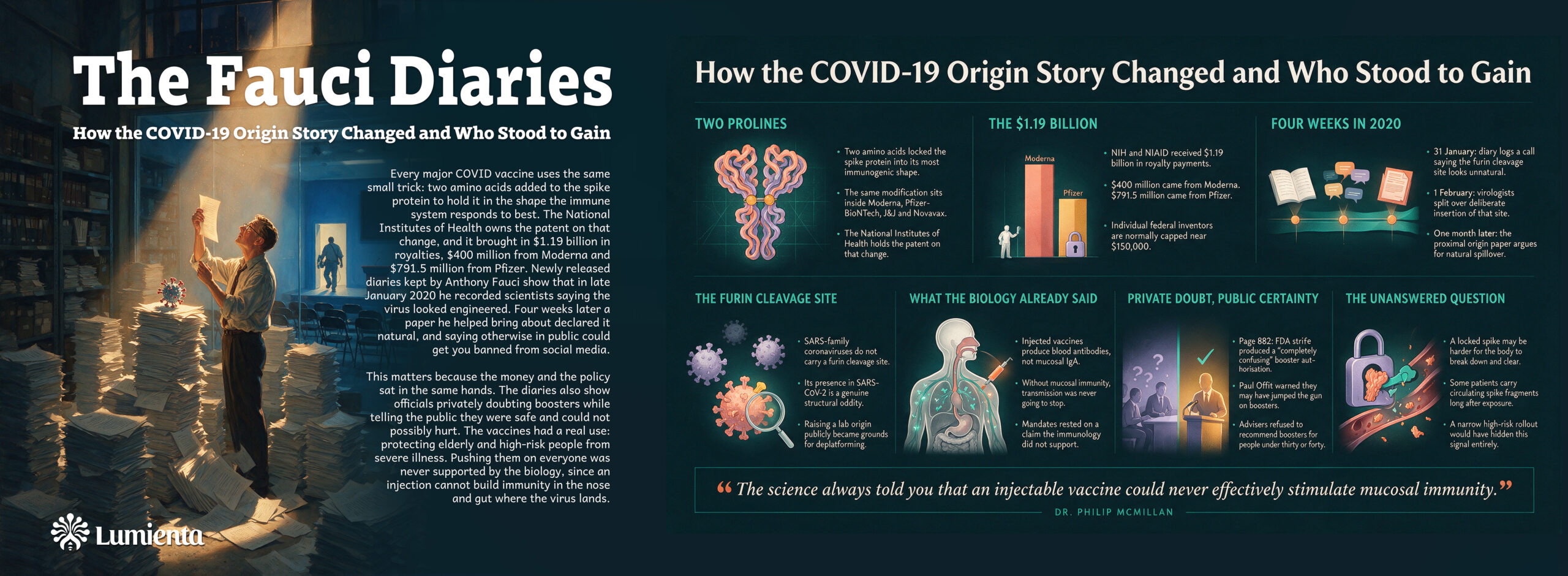
Infographic: The Fauci diaries
News: Medical news in brief
Education: Follow the signal. Test the evidence. Explore this gut course.
Read time: 6 minutes
FEATURE ARTICLE
COVID-19
The Fauci Diaries: How the COVID-19 Origin Story Changed and Who Stood to Gain
Authors: Dr. Philip McMillan, John McMillan

Senator Rand Paul released 1,141 pages of Anthony Fauci's diaries covering December 2019 through December 2022.
January 2020 entries record scientists questioning whether furin cleavage site mutations could have arisen naturally.
A spike stabilization patent held by NIH generated over a billion dollars from Moderna and BioNTech.
Injectable vaccines raise bloodstream antibodies but cannot reliably produce the mucosal immunity that blocks respiratory transmission.
Why this is important: Private notes from the official who shaped pandemic policy record doubts about viral origins that public messaging never acknowledged. With a federal patent earning over a billion dollars from vaccine makers, the diaries raise a question worth asking of any health authority: who benefited from the answer that prevailed?
BOOKS
|

FEATURED VIDEO
Fauci’s Diary: What Was Known Behind Closed Doors?

HEALTH
Large UK Care Home Trial Finds HEPA Air Filters Do Not Reduce Respiratory Infections
Paul Hunter and Julii Brainard, University of East Anglia

Ninety-one UK care homes were randomised, with forty-seven receiving HEPA filters in communal areas and forty-four acting as controls.
Infection rates among residents and staff showed no difference between homes with filters and homes without.
Staff absence from illness also failed to drop in the homes fitted with air filtration units.
Earlier trials in Australian care homes, German kindergartens and Swiss settings reported similarly disappointing results.
Why this is important: Air purifiers became a familiar fixture in schools, offices and care homes after the pandemic, sold on the promise of cleaner, safer air. Rigorous testing in the places most at risk found no protection against infection, which matters for anyone deciding where limited public health money should go.
INFOGRAPHIC
EDUCATION
This comprehensive data-led course focuses on the intestine as a pandemic amplifier. It is built around a eight-section deep dive through gut immunology, barrier injury, microbiome disruption, and the post-pandemic data dashboard

The Intestine as a Pandemic Amplifier is a comprehensive, data-led course - built around three drivers: repeated spike exposure, barrier injury, and microbiome disruption.
With seven modules, an interactive data dashboard, and Q&A, it takes you section by section through nine years of NHS admission data - so you understand what the numbers show and what they don't.
This is for those who want the evidence tested.
MEDICAL NEWS IN BRIEF
NEWS HIGHLIGHTS
🚥 Decades of Money Worries Leave Measurable Marks on Memory and Brain Volume, an Eighty-Year Study Finds: Financial strain is usually treated as an economic problem, not a medical one. Tracking the same people for eight decades suggests otherwise: chronic money stress appears to accelerate brain ageing itself, which reframes income support and debt relief as tools that may protect cognition, not merely budgets.
🚥 A Contagious Cancer Found in Catfish Raises the Question of Why Humans Are Spared: Cancer is normally a private disease, born and dying with one body. Four animal species prove it does not have to be. Working out exactly which human defences keep contagious tumours out is a way of mapping how the immune system recognises what belongs and what does not.
🚥 Fructose Released by Chemotherapy-Surviving Cancer Cells Signals Neighbouring Tumour Cells to Spread: Cancer that survives treatment has long been seen as dormant leftovers. Here those survivors turn out to be actively signalling, using a common dietary sugar to loosen their neighbours and help them escape. If it holds in patients, what people drink during chemotherapy may not be neutral. [SOURCE]
🚥 A Fibre-Derived Bacterial Compound Leaves the Gut Lining With Lasting Protection Against Inflammation: Gut lining cells were assumed to be short-lived barrier tissue with no memory. Evidence that they can hold a molecular imprint of past microbial signals changes what dietary fibre might be doing, and points toward treatments for inflammatory bowel disease that outlast the dose. [SOURCE]
🚥 Babies Raised Under Wartime Sugar Rationing Show Lower Dementia Rates Seven Decades Later: Britain's postwar rationing accidentally created a natural experiment no ethics board would approve. Its result suggests the first thousand days of life may set brain trajectories that only surface seventy years on. Being observational, it cannot prove cause, but it moves infant nutrition into dementia prevention. [SOURCE]
🚥 Blocking a Mitochondrial Transporter Silences the Inflammation of Ageing Cells Without Destroying Them: Anti-ageing research has largely tried to kill off worn-out cells. Turning down their inflammatory output instead may be safer and more precise, since these cells still perform useful work. A single transporter now offers a drug target for the low-grade inflammation underlying many diseases of ageing. [SOURCE]
SUPPORT VEJON MED
SUPPORT education in science and medicine. Your ONE-TIME donation will help us maintain our independence, compensate our dedicated team, and continue delivering high-quality content free from industry influence.
ADVERTISING
AI Is Moving Fast. Here's How to Keep Up.

AI is moving faster than any other technology. New models. New tools. New claims. New noise.
Most people feel like they're behind. But the people that don't, aren't smarter. They're just better informed.
The Future Today is a daily briefing for people who want clarity. In one concise email each day, you'll get the most important AI and tech developments, learn why they matter, and what they signal about what's coming next.
Written for operators, builders, leaders, and anyone who wants to sound sharp when AI comes up in the meeting.
One email. Five Minutes. Stay ahead of 99% of the world.
Stop Drowning In AI Information Overload

Your inbox is flooded with newsletters. Your feed is chaos. Somewhere in that noise are the insights that could transform your work—but who has time to find them?
The Deep View solves this. We read everything, analyze what matters, and deliver only the intelligence you need. No duplicate stories, no filler content, no wasted time. Just the essential AI developments that impact your industry, explained clearly and concisely.
Replace hours of scattered reading with five focused minutes. While others scramble to keep up, you'll stay ahead of developments that matter. 600,000+ professionals at top companies have already made this switch.
