
Sponsored by


A Message from Dr. McMillan
Certain cancers are rising, and some seem to be presenting at later stages, but calling this “turbo cancer” is weak framing because it lets the issue be dismissed as conspiracy.
The serious question is whether late-stage cancer presenting for the first time has increased since the pandemic, and whether this varies by cancer type, age group, immune status, or prior COVID exposure.
Patients deserve stage-specific, age-specific, and mechanism-informed research, not panic, denial, or language that helps serious questions get ignored.
Dr. Philip McMillan
In this week's May 29th, 2026 update:
Covid-19: The post-COVID signal in Norway and UK data
Vejon: This week’s featured Vejon video
Covid-19: A bed rest trial inspired modern evidence-based medicine
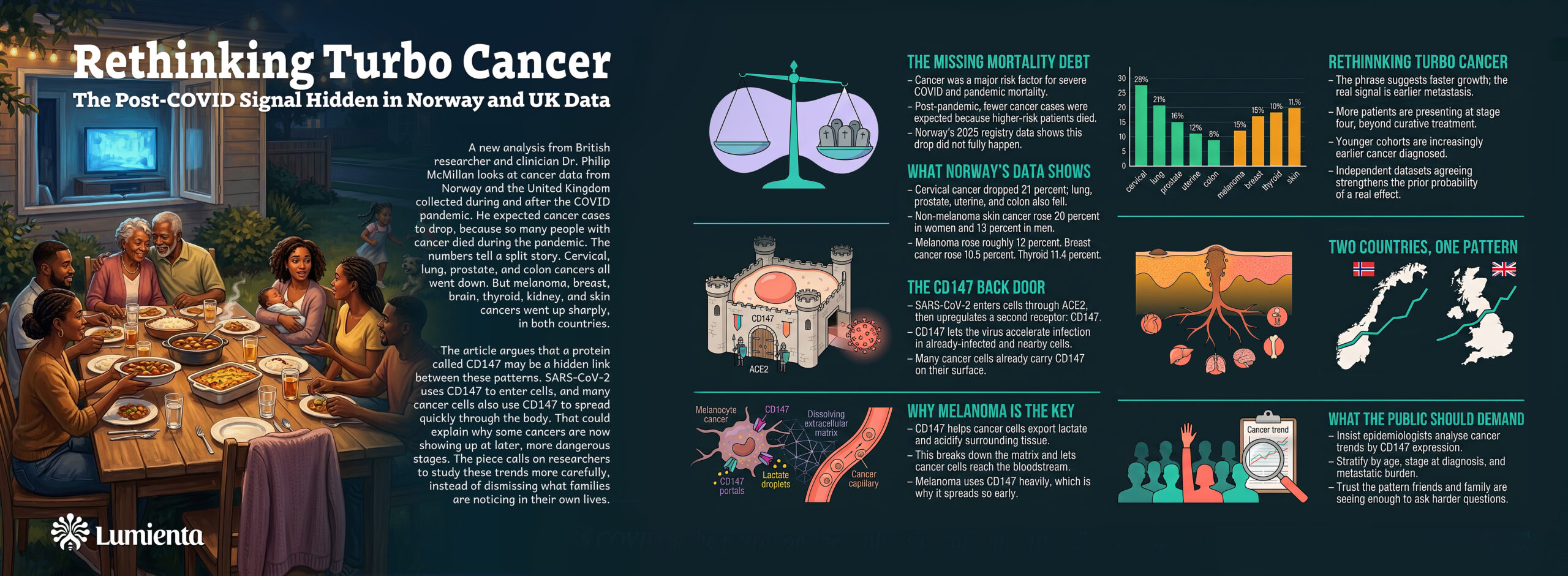
Infographic: Rethinking turbo cancer
News: Medical news in brief
Education: What changed in the liver after the pandemic? See the data for yourself?
Read time: 6 minutes
FEATURE ARTICLE
COVID-19
Rethinking Turbo Cancer: The Post-COVID Signal in Norway and UK Data
Authors: Dr. Philip McMillan, John McMillan

Norway's 2025 registry shows melanoma, thyroid, breast, and skin cancers rising while cervical, lung, and prostate cancers fall.
UK hospital data from 2016 to 2025 mirrors the same directional patterns across multiple independent datasets.
CD147, a protein exploited by both SARS-CoV-2 and aggressive tumors, may drive earlier tissue invasion and metastasis.
Screening rebound, demographic shifts, and coding changes cannot fully explain the rapid double-digit increases observed.
Why this is important: Cancer rates climbing after the pandemic may signal a shift in how tumors behave rather than how fast they grow. This analysis links CD147, a shared doorway for the virus and aggressive cancers, to earlier invasion and spread, urging researchers to track tumors by CD147 status.
SUPPORT VEJON MED
SUPPORT education in science and medicine. Your ONE-TIME donation will help us maintain our independence, compensate our dedicated team, and continue delivering high-quality content free from industry influence.
FEATURED VIDEO
The Post-Pandemic Cancer Puzzle Norway Just Exposed

HEALTH
How a trial on bedrest during the Korean war helped lead to evidence-based medicine
Helen Pearson, UCL

During the Korean War, Thomas Chalmers ran a randomized trial on hepatitis patients in Japan.
Soldiers recovered just as quickly whether confined to strict bed rest or allowed to move.
The result showed that common medical practice often lacked rigorous scientific support.
It inspired David Sackett to build evidence-based medicine, formally named in 1991.
Why this is important: A wartime experiment in the 1950s quietly upended a basic assumption, that rest speeds healing. By proving patients fared equally well while active, it showed medical tradition needs testing, not trust, seeding a discipline now ranked beside sanitation, vaccines, and antibiotics.
INFOGRAPHIC
EDUCATION
WHY ARE TOXIC LIVER DISEASE, FATTY LIVER,
AND MEDICATION REACTIONS RISING?
REAL DATA. REAL PATTERNS. EXPLORE THE SHIFT..

Many people are experiencing fatigue, gut symptoms, abnormal liver tests, and reduced tolerance to alcohol, medications, and supplements — even when standard investigations appear relatively normal.
What’s been missing is a systems-level explanation.
Most importantly, you’ll gain access to the framework and data analysis needed to understand the patterns for yourself.
MEDICAL NEWS IN BRIEF
NEWS HIGHLIGHTS
🚥 Antibodies From Long COVID Patients Triggered the Same Symptoms in Healthy Mice, Confirming an Autoimmune Driver: For millions left debilitated after COVID-19, this work pinpoints a concrete target: rogue antibodies turning the immune system against the body. By reproducing patients' pain in mice, researchers point toward treatments already on pharmacy shelves, while raising fresh questions about blood donation safety. [SOURCE]
🚥 A Vitamin D Drug Broke Down Pancreatic Cancer's Defenses and Boosted Chemotherapy Response in an Early Trial: Pancreatic cancer resists treatment partly because a fortress of tissue blocks both drugs and immune cells. Repurposing a cheap, already approved vitamin D medication appears to dismantle that barrier, helping chemotherapy work better and hinting at a simple test to predict who benefits most. [SOURCE]
🚥 A Heart Attack Floods the Brain With a Toxic Byproduct That Fuels Depression and Anxiety: Heart attack survivors often develop depression and anxiety, which in turn raise the odds of another cardiac event. Identifying a single toxic molecule that travels from the injured heart to the brain reveals why, and points to a drug that could protect both organs at once. [SOURCE]
🚥 Staying Fit in Your 30s Predicts More Elastic, Healthier Arteries Decades Later: Cardiovascular risk is usually judged by cholesterol, yet fitness may protect the heart in ways those numbers miss. Following Swedes for nearly 30 years, researchers found that staying aerobically fit from early adulthood kept arteries supple later in life, independent of lipids, blood pressure, and weight. [SOURCE]
🚥 Frailty in Older Age Is Not a One-Way Street and Can Often Be Reversed: Frailty is often treated as an inevitable slide into dependence, yet evidence shows many older people move back toward strength. Twice-weekly resistance training, adequate protein, staying socially active, and keeping the mind engaged can rebuild the reserve that helps the body weather illness and stress.
🚥 A New Once-Daily Pill Helps Maintain Weight Loss After Stopping GLP-1 Injections: Many people regain much of their lost weight soon after stopping injectable obesity drugs. A cheaper daily pill that holds most of those losses in place, while keeping blood sugar and blood pressure improvements, could make long-term weight management more affordable and easier to sustain.
BOOK NOOK

Set within a child’s nose, ‘Humming Heroes’ features a family of Lymphocytes led by a wise Mother, brave Father, determined Brother, and heroic Baby, confronting invading microorganisms. The story takes an imaginative turn, when a humming melody combines with the Lymphocytes’ song to repel the invaders and restore inner harmony.

"Disease X: Are You Prepared?" is your comprehensive guide to navigating the uncertain future of global health. Drawing from experience and the latest scientific insights, this book offers:
Practical strategies for personal and community preparedness.
Lessons learned from COVID-19 and other outbreaks.
Actionable steps to boost resilience against emerging health threats.
ADVERTISING
20 Million Pounds Lost With Method

The secret to lasting progress isn’t extreme diets or all-or-nothing routines—it’s small, consistent actions that actually fit your life. This science-backed approach helps you lose weight through simple, sustainable habits designed to work with your lifestyle, not against it—without restrictive meal plans or overwhelming gym schedules.
The results speak for themselves: users have already lost over 20 million pounds.
Take the quiz to get your personalized plan and stay accountable with small daily actions (plus a surprisingly honest companion to help keep you on track).
Stop These 6 Lash Mistakes

Thinner lashes after 50 aren’t “just aging”
It is also the way you're taking care of them...expired mascara, waterproof formulas, heated curlers, harsh preservatives, and more.
This page breaks down 6 things to stop today + what to use instead for lift without irritation. Read the lash tips.
