
Sponsored by


A Message from Dr. McMillan
Many people are now struggling with symptoms that remain unexplained or poorly understood within conventional medical frameworks.
The medical community is still grappling with why disease patterns appear to have shifted so significantly in recent years.
The case of Jordan Peterson, prominent Canadian psychologist, reflects just how difficult the next few years could become if we do not develop a clearer framework for understanding these emerging patterns of illness. This is what I have been developing.
Dr. Philip McMillan
In this week's April 24th, 2026 update:
Covid-19: The pattern behind Jordan Peterson's illness
Vejon: This week’s featured Vejon video
Health: Placebos may rival real drugs
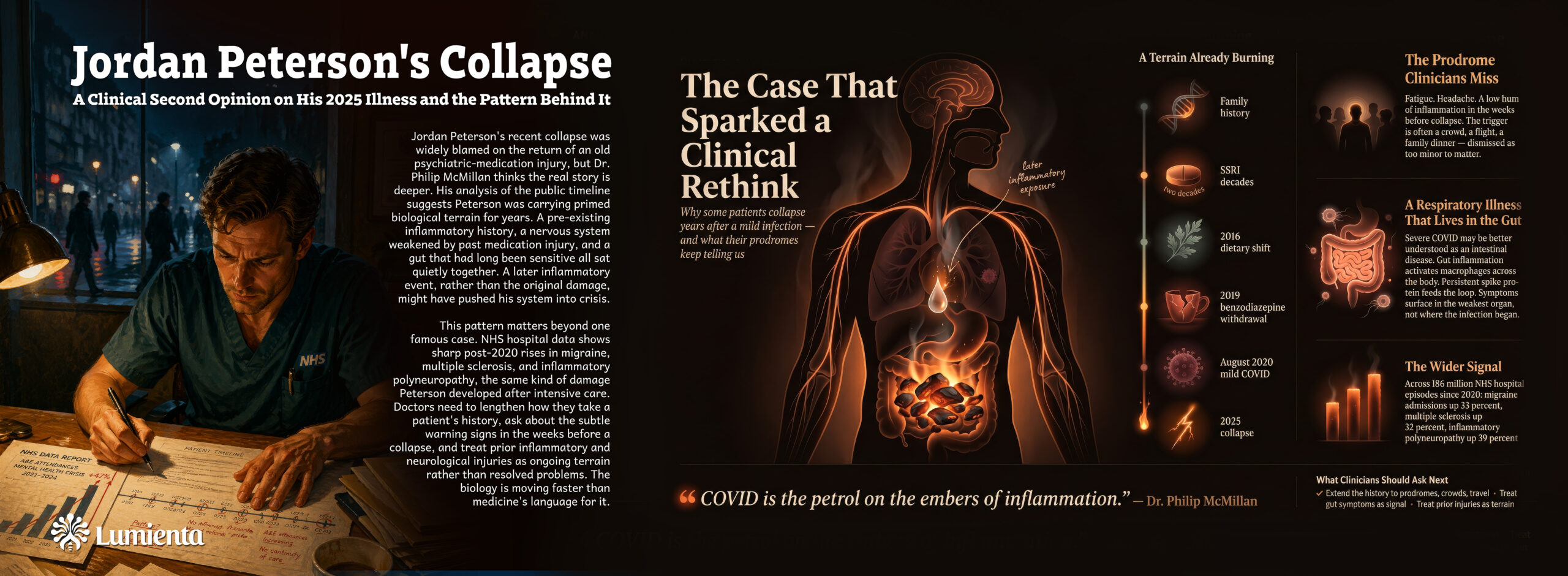
Infographic: Jordan Peterson's Collapse
News: Medical news in brief
Education: What changed in the brain after the pandemic? See the data for yourself?
Read time: 6 minutes
FEATURE ARTICLE
COVID-19
Jordan Peterson's Collapse: A Clinical Second Opinion on His 2025 Illness and the Pattern Behind It
Authors: Dr. Philip McMillan, John McMillan

Dr. Philip McMillan reframes Peterson's illness as post-COVID inflammation layered on earlier SSRI use and benzodiazepine withdrawal.
Severe COVID is argued to behave as an intestinal disease with respiratory and neurological consequences in vulnerable people.
NHS data reportedly show post-2020 surges in migraine admissions (33%), multiple sclerosis (32%), and inflammatory polyneuropathy (39%).
Dr. McMillan urges clinicians to take longer histories covering gut symptoms, prior immune injuries, and cumulative inflammatory priming.
Why this is important: Peterson's hospitalization fits a wider trend of post-viral inflammatory illness that current medical workups often miss. Recognizing cumulative damage from prior infections, medications, and gut disturbance could change how clinicians investigate sudden collapses, shifting attention from isolated triggers to layered immune priming built up across years.
SUPPORT VEJON MED
SUPPORT education in science and medicine. Your ONE-TIME donation will help us maintain our independence, compensate our dedicated team, and continue delivering high-quality content free from industry influence.
FEATURED VIDEO
Jordan Peterson’s Illness May Have Been Misunderstood

HEALTH
Placebos May Rival Real Drugs, But Your Body Seemingly Needs Social Permission Before Unlocking Its Healing Responses
Phil Starks, Tufts University

Placebos produce measurable shifts in brain activity, hormones, endorphins, dopamine, and immune signalling across many medical conditions.
Roughly one-third of irritable bowel syndrome patients improve on placebo alone, and sham surgeries match real procedures.
Open-label placebos still work, suggesting ritual, authority, and social context matter more than patient deception.
Authors frame placebo response as an evolved health governor gating costly healing resources based on perceived safety.
Why this is important: Healing responses appear to hinge on context, not just chemistry. Recognising placebo power as a biological circuit activated by trusted caregivers reshapes how clinicians design trials, craft consultations, and interpret subjective improvements, and raises ethical questions about whether warmth and authority are themselves part of effective medicine.
INFOGRAPHIC
EDUCATION
WHY ARE MIGRAINE, BRAIN FOG,
AND COGNITIVE DECLINE RISING?
REAL DATA. REAL PATTERNS. EXPLORE THE SHIFT.

What’s been missing is clarity.
This course gives you the framework to understand what may be happening.
But more importantly, it gives you access to a live neurological dashboard built from NHS data - so you can actually see the patterns for yourself.
Inside, you’ll be able to explore:
Which neurological conditions are rising
How trends changed after 2020
Where the strongest signals are emerging
How these patterns connect to real-world symptoms
This is not just theory. It’s a structured way to connect:
data
biology
and what people are experiencing day-to-day
MEDICAL NEWS IN BRIEF
NEWS HIGHLIGHTS
🚥 Microplastics Disturb Gut Bacteria and May Help Drive Inflammatory Bowel Disease, Early Human and Animal Evidence Suggests: Plastics are no longer only an environmental concern. Evidence that tiny fragments reshape the gut microbiome, starve protective bacteria, and exacerbate IBD models connects everyday packaging to intestinal disease. Understanding this pipeline could push food safety, water filtration, and bowel disease research forward in new directions simultaneously.
🚥 Around Half of AI Chatbot Health Answers Contain Problematic Claims, Even When Delivered With Total Confidence: Chatbots confidently deliver misleading medical information nearly half the time, yet users often trust their polished tone. Clinicians and health services should treat consumer AI answers as unreliable triage, and regulators may need stricter rules on referencing, disclaimers, and how models respond to open-ended patient questions.
🚥 Medications Disrupting Cholesterol Synthesis During Pregnancy Are Linked to a Sharply Higher Autism Risk in Offspring: Cholesterol biology is central to fetal brain development. Connecting a fast-growing slice of common psychiatric and cardiovascular prescriptions to measurable autism risk could reshape prenatal prescribing, inform clinician monitoring, and sharpen conversations between pregnant patients and physicians about safer alternatives for long-term mental and cardiovascular care. [SOURCE]
🚥 Misfolded Proteins in Gut Biopsies Can Flag Dementia, Parkinson's, and Motor Neuron Disease Roughly Seven Years Early: Neurodegeneration may start quietly in the gastrointestinal tract long before brain symptoms appear. Routine biopsies, already taken during digestive workups, could become early warning tools for dementia, Parkinson's, and MND, giving clinicians a chance to intervene or monitor years before memory loss or movement problems set in. [SOURCE]
🚥 Anemia in Older Adults Is Tied to 66% Higher Dementia Risk, Climbing Further When Alzheimer's Biomarkers Are Present: Anemia is usually treated as a benign, fixable issue in older adults. Evidence that it accelerates brain decline, especially in men and patients already carrying Alzheimer's biomarkers, argues for routine hemoglobin screening in dementia prevention, and for tighter integration between primary care, hematology, and cognitive neurology. [SOURCE]
🚥 A Naturally Occurring Amino Acid, L-Arginine, Blocks Alzheimer's-Linked Tau Fibrils Without Disrupting Normal Protein Function: Separating disease-driving protein clumping from the healthy condensates that neurons depend on has been a major hurdle in Alzheimer's drug design. Pinpointing the droplet interface as the key reaction site, plus a simple, available molecule that controls it, opens a cleaner path toward safer neurodegenerative therapeutics. [SOURCE]
BOOK NOOK

Set within a child’s nose, ‘Humming Heroes’ features a family of Lymphocytes led by a wise Mother, brave Father, determined Brother, and heroic Baby, confronting invading microorganisms. The story takes an imaginative turn, when a humming melody combines with the Lymphocytes’ song to repel the invaders and restore inner harmony.

"Disease X: Are You Prepared?" is your comprehensive guide to navigating the uncertain future of global health. Drawing from experience and the latest scientific insights, this book offers:
Practical strategies for personal and community preparedness.
Lessons learned from COVID-19 and other outbreaks.
Actionable steps to boost resilience against emerging health threats.
ADVERTISING
The Key to Better aging: More NAD+

Most skincare works on the surface. Aramore goes where real aging begins: the basal layer of the skin, where new cells form. Backed by decades of research from Harvard and MIT scientists, Aramore is the first topical system designed to support skin’s NAD+ — the molecule your cells rely on for repair, energy, and resilience.
As NAD+ naturally declines with age, visible changes follow: dullness, uneven tone, fine lines, and loss of firmness. Aramore’s unique complex of NAD+ precursors, ketones, and fatty acids helps replenish cells at the source for skin that acts healthier and younger.
Clinically shown to improve tone, radiance, smoothness, and firmness as soon as 28 days.
The Anti-Aging Solution Men Actually Use

Over 1,000,000 men have made Particle part of their routine. One product. Multiple premium anti-aging ingredients. Clinically researched and engineered for men's skin. Reduces eye bags, dark spots, and wrinkles without adding complexity to your morning. Easy, effective, worth it. Get 20% off now with the code BH20.
