
In partnership with


A Message from Dr. McMillan
The lesson from COVID should have been clear: no stone should be left unturned in understanding how SARS-CoV-2 acquired the features that allowed it to move into humans and spread globally.
The furin cleavage site remains one of the most important unresolved questions, because it may help explain why this virus had pandemic potential in a way closely related viruses did not.
If a future pathogen such as hantavirus were ever altered to become more transmissible between humans, the world would have no right to act surprised - we chose not to ask the hardest questions when we had the chance.
Dr. Philip McMillan
In this week's May 8th, 2026 update:
Disease: Cruise ship with signs of human-to-human Hantavirus spread
Vejon: This week’s featured Vejon video
Disease: Why the MV Hondius Hantavirus cluster raises rare questions
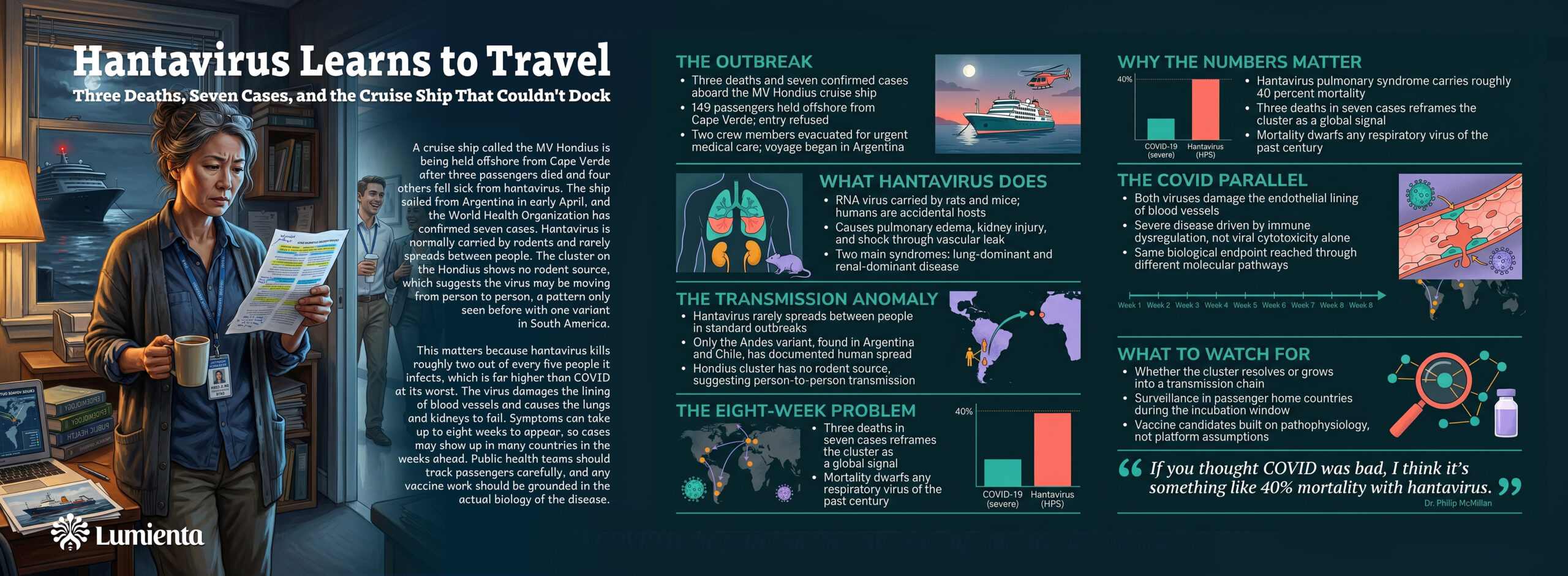
Infographic: Hantavirus learns to travel
News: Medical news in brief
Education: What changed in the brain after the pandemic? See the data for yourself?
Read time: 6 minutes
FEATURE ARTICLE
DISEASE
Hantavirus Learns to Travel: Three Deaths, Seven Cases, and the Cruise Ship That Couldn't Dock
Authors: Dr. Philip McMillan, John McMillan

The MV Hondius reported seven confirmed cases and three deaths after sailing from Argentina in early April 2026.
The Andes variant identified can occasionally pass between people, unlike most hantaviruses transmitted via rodent excreta.
Symptom timelines and contact patterns suggest both pre-boarding rodent exposure and possible onboard person-to-person transmission.
Hantavirus damages blood vessel linings, causing fluid leakage, severe lung injury, and roughly 40 percent mortality
Why this is important: Hantaviruses rarely jump between humans, so any cluster aboard a closed environment like a cruise ship demands urgent attention. Cape Verde's quarantine, viral sequencing and contact tracing now matter for global public health. Findings here will shape how outbreak teams respond to emerging zoonotic threats in mobile populations.
SUPPORT VEJON MED
SUPPORT education in science and medicine. Your ONE-TIME donation will help us maintain our independence, compensate our dedicated team, and continue delivering high-quality content free from industry influence.

HEALTH
A Virologist Explains Why the MV Hondius Hantavirus Cluster Raises Rare Questions About Person-to-Person Spread
Phil Starks, Tufts University

WHO reports eight suspected cases and three deaths aboard the ship from Argentina, with three confirmed by lab.
Andes virus, identified in this cluster, has shown limited human-to-human transmission in past Argentine outbreaks.
Symptom onset five days after departure suggests pre-boarding rodent exposure, not necessarily shipboard transmission.
Sequencing the virus will reveal whether mutations enabled transmission or whether environmental sources better explain spread.
Why this is important: Most hantaviruses do not pass between people, so this cluster sits at the edge of known biology. Investigators must distinguish shared rodent exposure from direct contact, since the answer changes how the next outbreak is managed. WHO assesses global risk as low while sequencing continues.
INFOGRAPHIC
EDUCATION
WHY ARE TOXIC LIVER DISEASE, FATTY LIVER,
AND MEDICATION REACTIONS RISING?
REAL DATA. REAL PATTERNS. EXPLORE THE SHIFT..

Many people are experiencing fatigue, gut symptoms, abnormal liver tests, and reduced tolerance to alcohol, medications, and supplements — even when standard investigations appear relatively normal.
What’s been missing is a systems-level explanation.
Most importantly, you’ll gain access to the framework and data analysis needed to understand the patterns for yourself.
MEDICAL NEWS IN BRIEF
NEWS HIGHLIGHTS
🚥 Modern Research Suggests Linus Pauling Was Partly Right That High-Dose Vitamin C Might Fight Cancer Cells: Decades of dismissal followed Pauling's bold claim, yet modern oncology now revisits intravenous vitamin C as a possible adjunct therapy. Understanding why oral and IV delivery behave so differently helps clarify which patients might benefit. Larger randomised trials are needed before clinical adoption beyond experimental settings.
🚥 Sustained Loss of Abdominal Fat Helps Preserve Cognitive Function and Slows Brain Aging in Midlife: Belly fat is more than a cosmetic concern. By tying visceral fat reduction directly to slower brain ageing through glucose control, researchers identify a measurable midlife target. Lifestyle and metabolic interventions could meaningfully delay cognitive decline, regardless of overall weight loss outcomes. [SOURCE]
🚥 At-Home Finger-Prick Blood Tests Combined With Online Brain Games Could Screen People for Dementia Risk: Earlier dementia detection means earlier intervention. Combining a finger-prick test with home cognitive assessments could let primary care identify at-risk patients before symptoms appear, easing pressure on overstretched memory clinics. Scaling this approach may transform population-level screening for Alzheimer's and other dementias. [SOURCE]
🚥 Whooping Cough Often Goes Undiagnosed in Adults Despite Causing Weeks of Severe Coughing Fits: Whooping cough creates weeks of disabling coughing in adults, yet many cases go unnoticed. Recognising pertussis early shortens transmission, prevents pneumonia and rib fractures, and protects unvaccinated infants who are most at risk of severe disease. Booster vaccination remains the most effective prevention strategy.
🚥 Researchers Identify the Cellular Mechanism Behind a Fast-Acting Magnetic Brain Stimulation Therapy for Depression: Magnetic brain stimulation already helps treatment-resistant depression, but until now nobody knew exactly which cells it repaired. Pinpointing the prefrontal cortex circuit involved opens doors for treating chronic pain, OCD, PTSD and tinnitus, all of which involve disrupted brain circuits and may respond to similar approaches. [SOURCE]
🚥 A Single High Dose of Psilocybin Produces Lasting Brain Changes Linked to Improved Well-Being: Psilocybin therapy is moving from anecdote to mechanism. Mapping how a single dose reshapes neural connectivity and predicts well-being gains may help clinicians target who benefits most. As regulatory frameworks evolve, evidence like this strengthens the case for cautious medical access in psychiatry. [SOURCE]
BOOK NOOK

Set within a child’s nose, ‘Humming Heroes’ features a family of Lymphocytes led by a wise Mother, brave Father, determined Brother, and heroic Baby, confronting invading microorganisms. The story takes an imaginative turn, when a humming melody combines with the Lymphocytes’ song to repel the invaders and restore inner harmony.

"Disease X: Are You Prepared?" is your comprehensive guide to navigating the uncertain future of global health. Drawing from experience and the latest scientific insights, this book offers:
Practical strategies for personal and community preparedness.
Lessons learned from COVID-19 and other outbreaks.
Actionable steps to boost resilience against emerging health threats.
ADVERTISING
Become An AI Expert In Just 5 Minutes

If you’re a decision maker at your company, you need to be on the bleeding edge of, well, everything. But before you go signing up for seminars, conferences, lunch ‘n learns, and all that jazz, just know there’s a far better (and simpler) way: Subscribing to The Deep View.
This daily newsletter condenses everything you need to know about the latest and greatest AI developments into a 5-minute read. Squeeze it into your morning coffee break and before you know it, you’ll be an expert too.
Subscribe right here. It’s totally free, wildly informative, and trusted by 600,000+ readers at Google, Meta, Microsoft, and beyond.
You’re 28 days away from firmer, glowier skin.

Aramore’s MIT & Harvard co-founders developed a special complex to help boost back skin’s NAD+, the molecule that controls how we age. Best part: you’ll see results in just one skin cycle, or 28 days.
Start your skin transformation with 20% off. Use code NEWSLETTER20.
