
In partnership with


A Message from Dr. McMillan
One of the most important lessons from my conversation with Susan Langlois is that it is in no one’s long-term interest for a medical product to be accepted without the necessary checks, safeguards, and honest follow-up.
If there are unresolved questions about safety, distribution, long-term effects, or population-level harm, then the scientific and medical community has a duty to insist that those questions are properly investigated.
In the end, companies may move on to the next product or platform, but health responsibility will remain with the doctors, regulators, and institutions who allowed public trust to be broken.
Dr. Philip McMillan
In this week's July 3rd, 2026 update:
Covid-19: A vaccine developer's warning
Vejon: This week’s featured Vejon video
Disease: Rising heat threatens people with interstitial lung disease
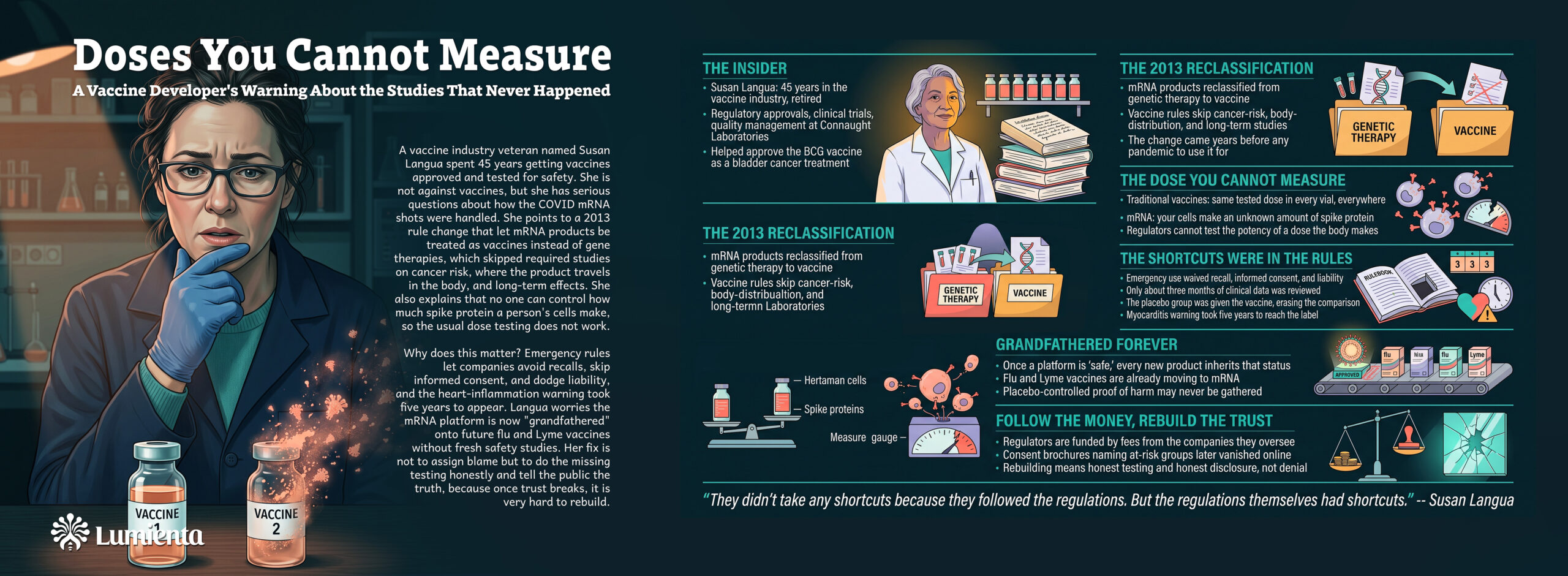
Infographic: Doses you cannot measure
News: Medical news in brief
Education: Heal yourself. Help others. Learn the ROOT approach
Read time: 6 minutes
FEATURE ARTICLE
COVID-19
Doses You Cannot Measure: A Vaccine Developer's Warning About the Studies That Never Happened
Authors: Dr. Philip McMillan, John McMillan

In 2013, mRNA products were reclassified from genetic therapies to vaccines, dropping cancer and biodistribution studies.
Each cell produces spike protein at varying levels, so no regulator can measure the actual dose delivered.
Emergency provisions waived recalls, informed consent, and liability while review used only three months of data.
New mRNA products inherit the platform's safety designation, avoiding foundational studies and creating a self-reinforcing scrutiny gap.
Why this is important: Novel medical platforms deserve adequate scrutiny before mass deployment. Langlois argues that mRNA vaccines skipped foundational safety studies once reserved for genetic technologies, leaving myocarditis risks discovered years later. Her warning matters because each new mRNA product may inherit approval without independent testing, quietly lowering the bar for public safety.
SUPPORT VEJON MED
SUPPORT education in science and medicine. Your ONE-TIME donation will help us maintain our independence, compensate our dedicated team, and continue delivering high-quality content free from industry influence.
FEATURED VIDEO
What a Vaccine Industry Insider Noticed During COVID

HEALTH
Rising Heat Threatens People With Interstitial Lung Disease by Deepening Breathlessness and Worsening Air Quality
anne-marie Russell, University of Birmingham

Interstitial lung disease covers over 200 conditions that scar and stiffen lungs, reducing oxygen transfer.
Extreme heat raises the body's oxygen demand, intensifying breathlessness, fatigue, and reduced exercise tolerance for patients.
Heatwaves boost ground-level ozone, wildfire smoke, and airborne particles that irritate lungs and may accelerate progression.
Patients should track weather alerts, stay cool and hydrated, maintain oxygen supplies, and watch warning symptoms.
Why this is important: Climate change is not an abstract threat for people whose lungs are already scarred. As heatwaves grow more frequent, patients with interstitial lung disease face sharper breathlessness and dirtier air that can speed decline. Simple planning, from cooling to oxygen readiness, becomes life-protecting, and neighbours watching over isolated patients matters.
INFOGRAPHIC
EDUCATION

The McMillan Community is home to the ROOT Approach - a clear, structured system for understanding inflammation, health timelines, and recovery.
We are building a 12-week guided course designed to help you apply ROOT principles to your own health first, and then safely support others through education, insight, and pattern recognition.
This is for those who want understanding — not shortcuts.
MEDICAL NEWS IN BRIEF
NEWS HIGHLIGHTS
🚥 A Large Review Finds Adults Recall Childhood Maltreatment Consistently Over Years, Countering Doubts About Memory Reliability: Survivors are often doubted when they describe early abuse or neglect. Coleman and Danese show these accounts hold steady across years, giving clinicians and courts more confidence in what people report. Reliable recall also means a single interview can guide care, and adolescence emerges as a key moment to intervene.
🚥 Psychology Research Maps What a Healthy Relationship With Your Hair Looks Like and Why It Shapes Wellbeing: Few people question the running commentary they aim at their own hair, yet that inner dialogue shapes confidence and self-image. Anastasiades reframes hair care as a relationship built on curiosity and self-compassion, not control. Treating a bad hair day as information, not judgment, can quietly improve how we see ourselves. [SOURCE]
🚥 An AI System Reads Routine Retinal Photos to Flag Six Major Diseases Within Seconds: A photograph of the eye may soon double as a broad health check. Trained on primary-care images, this AI screens for six conditions without blood draws or specialist gear, using only a standard camera. That speed and low cost could widen access in remote and underserved communities that lack laboratories. [SOURCE]
🚥A Meta-Analysis Finds Melatonin Eases Chronic Musculoskeletal Pain About as Much as Standard Painkillers: A cheap sleep supplement may hold surprising promise for pain. Sydney researchers pooled two dozen trials and found melatonin reduced chronic musculoskeletal pain nearly as well as opioids or anti-inflammatories, with side effects no worse than placebo. That safety profile could offer a gentler option amid worries about painkiller dependence. [SOURCE]
🚥 Mounting Evidence Ties E-Cigarette Chemicals, Including Synthetic Coolants, to Serious Heart Risks: Vaping is often sold as the safer choice, but the heart tells a different story. New findings connect the sweet, cooling additives in e-cigarettes to dangerous rhythm disturbances, while nicotine strains blood vessels and fuels atherosclerosis. For young users especially, the cardiovascular stakes undercut assumptions that vapor is harmless. [SOURCE]
🚥 Cystic Fibrosis Begins in the Gut, Not Just the Lungs, Reshaping How the Disease Is Understood: Calling cystic fibrosis a lung disease misses where it often starts and where new dangers lie. Ooi shows the gut is central, with digestive symptoms in every patient and growing colorectal cancer risk as people live longer. Understanding this shifts screening and care toward the whole body, not only breathing. [SOURCE]
ADVERTISING
The Wild World of the Van Gogh Truthers

In 1990, after years of practicing medicine and reviewing Van Gogh’s case history via his hundreds of letters, Arenberg published a paper in JAMA diagnosing Van Gogh as suffering not from epilepsy, as the artist’s physician claimed a century earlier, but from Ménière’s disease, an inner-ear affliction that can cause vertigo, of which Van Gogh complained, and tinnitus, a persistent ringing in the ears. Ménière’s, to Arenberg, could better explain Van Gogh’s decision to slice off his ear. After retiring, in 2017, Arenberg recommitted himself to studying Van Gogh and became convinced that art historians had made an even more alarming mistake: Van Gogh had not committed suicide. He’d been murdered.
Read the article for free on Air Mail, a lively digital read for the world citizen, with stories both foreign and domestic that you won’t find anywhere else, written by some of the world’s finest journalists.
Privacy-first email. Built for real protection.

End-to-end encrypted, ad-free, and open-source. Proton Mail protects your inbox with zero data tracking.
