
In partnership with


A Message from Dr. McMillan
An ideological approach to COVID risks suppressing the very investigations needed to identify potential problems, including findings such as higher mortality signals in certain subgroups like single-dose recipients.
In any complex system, safety depends on actively searching for weaknesses, much like software developers rely on ethical “hackers” to expose vulnerabilities.
My role is to challenge assumptions and probe these signals so that risks can be properly understood and addressed.
Dr. Philip McMillan
In this week's March 20th, 2026 update:
Covid-19: The vaccinated are fine and the unvaccinated aren't dying
Vejon: This week’s featured Vejon video
Health: Advances could help humanity outrun the antibiotic resistance
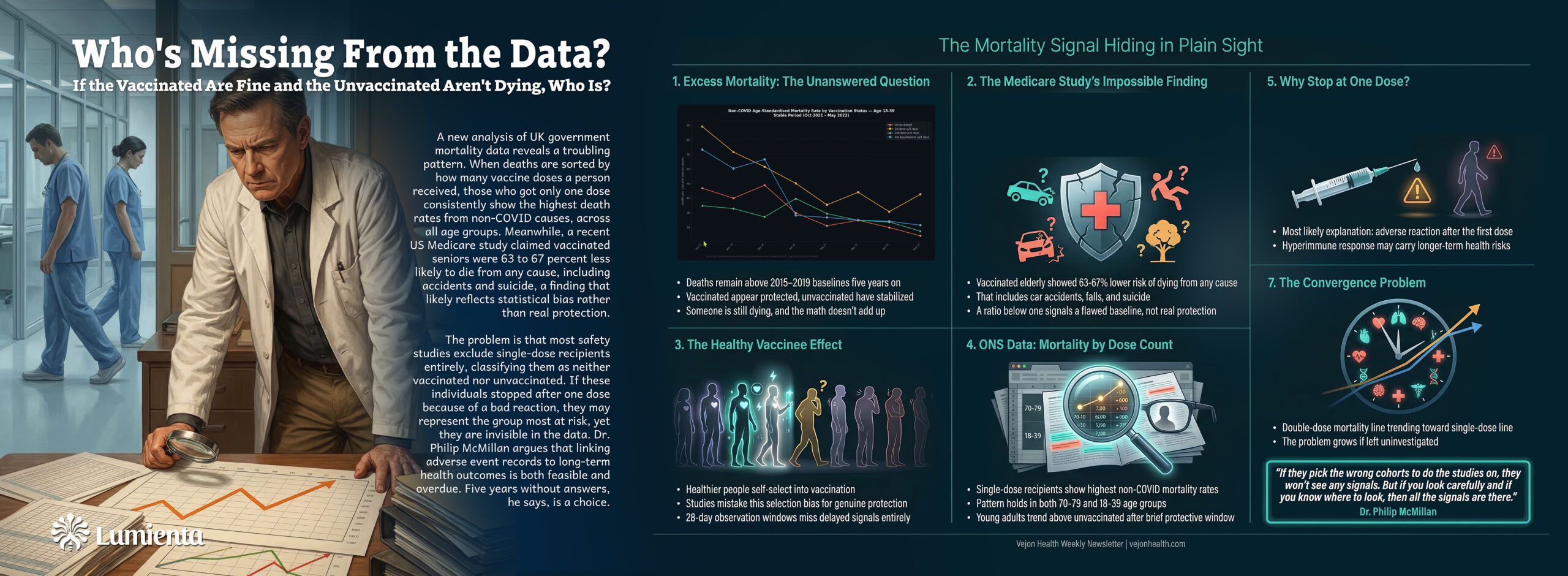
Infographic: Who's missing from the excess deaths data?
News: Medical news in brief
Education: Post COVID phenotypes - What makes you unique?
Read time: 6 minutes
FEATURE ARTICLE
COVID-19
Who's Missing From the Excess Deaths Data? If the Vaccinated Are Fine and the Unvaccinated Aren't Dying, Who Is?
Authors: Dr. Philip McMillan, John McMillan

Excess mortality in Western nations remains elevated five years after the pandemic, with no clear explanation from official sources.
ONS data shows single-dose COVID vaccine recipients have the highest non-COVID age-standardized mortality rates across all age groups.
Most safety studies exclude partially vaccinated people, removing the cohort most likely to have experienced adverse reactions.
Double-dose mortality trends are converging upward toward single-dose levels, suggesting the pattern may worsen over time.
Why this is important: Publicly available UK mortality data, stratified by COVID vaccine dose count, reveals a troubling pattern. People who received only one COVID vaccine dose show persistently elevated non-COVID death rates, yet most safety studies exclude this group entirely. Linking adverse event records to long-term health outcomes could finally clarify whether this statistical blind spot conceals a real and growing signal.
SUPPORT VEJON MED
SUPPORT education in science and medicine. Your ONE-TIME donation will help us maintain our independence, compensate our dedicated team, and continue delivering high-quality content free from industry influence.

COVID-19
Four Emerging Advances Could Help Humanity Outrun the Antibiotic Resistance Crisis
Author: Andre O. Hudson, Rochester Institute of Technology

Over 2.8 million antibiotic-resistant infections occur annually in the U.S., linked to nearly 5 million deaths worldwide.
Rapid diagnostic tools using genomic sequencing and AI can identify effective treatments in hours, not days.
Bacteriophage therapy, CRISPR antimicrobials, and nanoparticle delivery systems bypass traditional drug resistance mechanisms entirely.
The proposed PASTEUR Act would provide up to $3 billion in subscription-based funding for antibiotic development.
Why this is important: A Nevada woman died in 2016 from an infection resistant to all 26 available U.S. antibiotics. Faster diagnostics, engineered virus therapies, gene-editing tools, and new government funding models now offer realistic paths forward before routine surgeries and cancer treatments become life-threatening gambles.
INFOGRAPHIC
EDUCATION

This short tool maps symptom patterns and highlights which systems may need attention first - because with Post-COVID patterns, order of therapy often matters more than severity of symptoms.
If you’re living with ongoing symptoms or know someone who is, I would encourage you to click on the link, create a record of your symptoms and learn more about what they may mean.
MEDICAL NEWS IN BRIEF
NEWS HIGHLIGHTS
🚥 Your Brain Encodes Memories in Rhythmic Pulses, Not as a Continuous Stream: Learning does not happen in a steady flow. University of Toronto researchers discovered that the brain's ability to form new memories pulses several times per second, synchronized with theta brain waves. These findings could reshape educational strategies and inform treatments for memory disorders by targeting the precise rhythms underlying recall. [SOURCE]
🚥 Scientists Used CRISPR to Build Cancer-Fighting CAR-T Cells Directly Inside the Body for the First Time: Building cancer-killing immune cells currently requires extracting a patient's blood, engineering it in a lab, and reinfusing it at enormous cost. UCSF scientists bypassed this entire process with a single injection that reprograms T cells where they already live. If validated in humans, it could bring life-saving immunotherapy to far more patients worldwide. [SOURCE]
🚥 Newly Discovered Viruses Hiding Inside Gut Bacteria Are Twice as Common in Colorectal Cancer Patients: Danish researchers discovered viral hitchhikers buried inside a common gut bacterium that appear far more frequently in people with colorectal cancer. While association does not prove causation, the finding opens a new frontier in understanding how the gut microbiome contributes to cancer and could eventually supplement current screening tools. [SOURCE]
🚥 The Appendix Evolved Independently at Least 32 Times, Suggesting It Is Far From Useless: Far from a vestigial leftover, the appendix may function as a safe house for beneficial gut bacteria during illness. Its repeated independent evolution across dozens of mammalian species suggests real survival value, though modern sanitation has shifted the balance, making appendicitis a greater threat than the infections it once helped overcome. [SOURCE]
🚥A Simple Nasal Swab Could Detect Alzheimer's Disease Before Memory Loss Begins: Catching Alzheimer's before symptoms appear remains one of medicine's greatest challenges. Duke researchers found that a brief nasal swab, collecting olfactory nerve cells just inside the nose, reveals distinctive gene activity patterns in early disease. At 81% accuracy, this low-cost, non-invasive approach could transform screening and open the door to preventive treatment. [SOURCE]
🚥 Smart Hydrogel Wound Dressing Releases Antibiotics Only When Harmful Bacteria Are Detected: Antibiotic overuse in wound care accelerates resistance, yet undertreating infections risks serious complications. Brown University engineers solved this dilemma with a hydrogel that stays sealed until pathogenic bacteria trigger it, releasing antibiotics precisely when needed. In mice, a single application cleared infections completely while leaving beneficial skin bacteria undisturbed. [SOURCE]
BOOK NOOK

Set within a child’s nose, ‘Humming Heroes’ features a family of Lymphocytes led by a wise Mother, brave Father, determined Brother, and heroic Baby, confronting invading microorganisms. The story takes an imaginative turn, when a humming melody combines with the Lymphocytes’ song to repel the invaders and restore inner harmony.

"Disease X: Are You Prepared?" is your comprehensive guide to navigating the uncertain future of global health. Drawing from experience and the latest scientific insights, this book offers:
Practical strategies for personal and community preparedness.
Lessons learned from COVID-19 and other outbreaks.
Actionable steps to boost resilience against emerging health threats.
ADVERTISING
The business side of healthcare

If your healthcare news feels scattered, that’s because it probably is.
Healthcare Brew pulls it together—covering pharma, policy, health tech, and hospital operations in a free newsletter built for the business side of healthcare.
Clear context. Industry interviews. Engaging reporting. Read by 135,000+ professionals who want to know what matters without digging for it.
Become An AI Expert In Just 5 Minutes

If you’re a decision maker at your company, you need to be on the bleeding edge of, well, everything. But before you go signing up for seminars, conferences, lunch ‘n learns, and all that jazz, just know there’s a far better (and simpler) way: Subscribing to The Deep View.
This daily newsletter condenses everything you need to know about the latest and greatest AI developments into a 5-minute read. Squeeze it into your morning coffee break and before you know it, you’ll be an expert too.
Subscribe right here. It’s totally free, wildly informative, and trusted by 600,000+ readers at Google, Meta, Microsoft, and beyond.
