
In partnership with


A Message from Dr. McMillan
The pandemic revealed an uncomfortable truth: too much of modern medicine is structured around profiting from illness rather than preventing it.
Vitamin D is a clear example — a cheap, safe, biologically plausible strategy was never given the same urgency as expensive pharmaceutical interventions.
Until patients are placed back at the centre of medicine, we will keep mistaking profitable treatment pathways for genuine health solutions.
Dr. Philip McMillan
In this week's May 1st, 2026 update:
Covid-19: Paxlovid trial reveals limited benefit in vaccinated patients
Vejon: This week’s featured Vejon video
Health: Cancers are rising sharply in England's under-50s
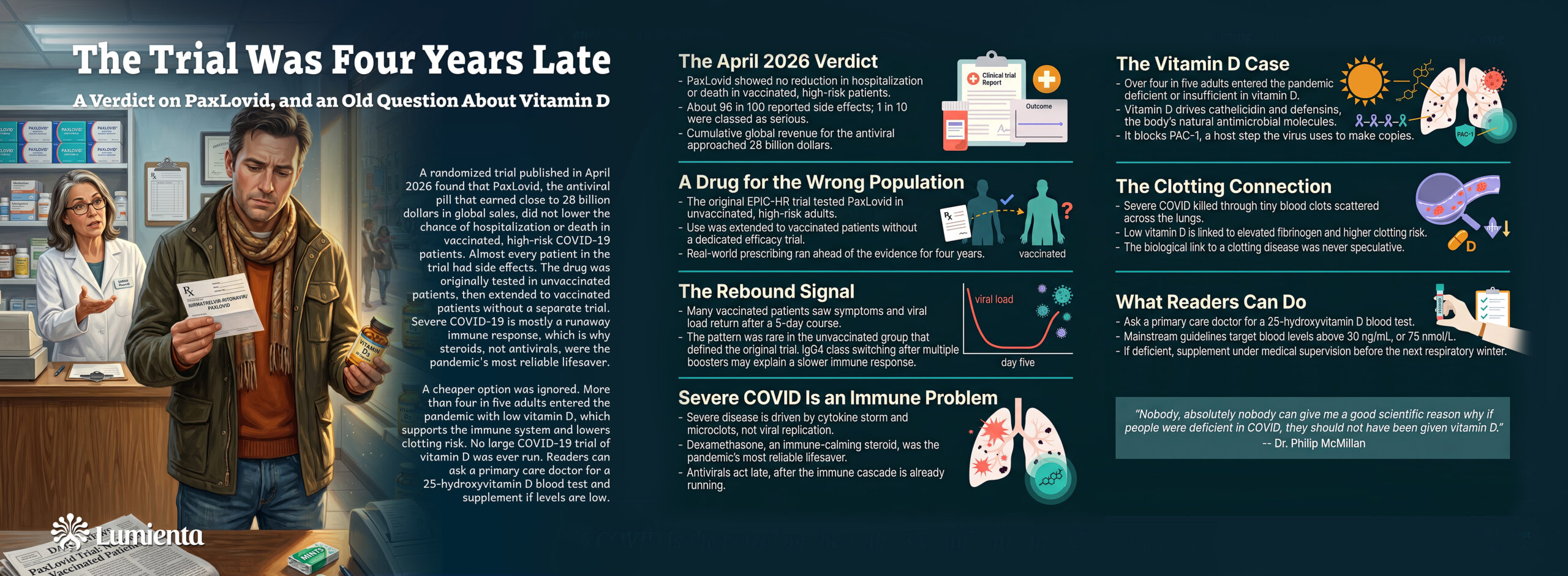
Infographic: The trial was four years late
News: Medical news in brief
Education: What changed in the brain after the pandemic? See the data for yourself?
Read time: 6 minutes
FEATURE ARTICLE
COVID-19
The Trial Was Four Years Late: A Verdict on Paxlovid and an Old Question About Vitamin D
Authors: Dr. Philip McMillan, John McMillan

An April 2026 clinical trial showed Paxlovid did not reduce hospitalization or death in vaccinated, high-risk patients.
Around 96 of every 100 trial participants experienced side effects, with roughly one in ten classified as serious.
Original authorization extrapolated unvaccinated trial results to vaccinated populations without proper testing in that group.
Vitamin D supports antimicrobial peptides, regulates ACE2 receptors, modulates lung inflammation, and reduces clotting risk.
Why this is important: Regulators leaned heavily on Paxlovid while neglecting vitamin D, despite over 80% of UK and US adults being deficient before the pandemic. A delayed trial now exposes that gap, raising serious questions about how cheap, biologically plausible interventions are sidelined when costlier therapies attract investment.
SUPPORT VEJON MED
SUPPORT education in science and medicine. Your ONE-TIME donation will help us maintain our independence, compensate our dedicated team, and continue delivering high-quality content free from industry influence.

HEALTH
Eleven cancers are rising sharply in England's under-50s, with lifestyle factors taking centre stage
Phil Starks, Tufts University

Eleven cancer types, including breast, bowel, melanoma, and pancreatic, are rising in adults under 50 in England.
Cancer incidence in those aged 25 to 49 has risen by roughly a quarter since the early 1990s.
Excess body weight ranks as the second biggest preventable cancer cause in the UK after smoking.
Ultra-processed foods, alcohol, sedentary work, and disrupted sleep schedules appear to amplify risk in younger adults.
Why this is important: Cancer was long viewed as an older person's disease. Rising rates in younger adults change that picture and place lifestyle, diet, and environmental exposures at the centre of prevention. Identifying modifiable drivers now could reduce decades of future disease burden across an entire generation.
INFOGRAPHIC
EDUCATION
WHY ARE MIGRAINE, BRAIN FOG,
AND COGNITIVE DECLINE RISING?
REAL DATA. REAL PATTERNS. EXPLORE THE SHIFT.

What’s been missing is clarity.
This course gives you the framework to understand what may be happening.
But more importantly, it gives you access to a live neurological dashboard built from NHS data - so you can actually see the patterns for yourself.
Inside, you’ll be able to explore:
Which neurological conditions are rising
How trends changed after 2020
Where the strongest signals are emerging
How these patterns connect to real-world symptoms
This is not just theory. It’s a structured way to connect:
data
biology
and what people are experiencing day-to-day
MEDICAL NEWS IN BRIEF
NEWS HIGHLIGHTS
🚥 Cortical blindness from birth appears to fully prevent schizophrenia, hinting at vision's role in psychiatric risk: Schizophrenia remains one of psychiatry's most stubborn puzzles. A protective effect linked to early visual cortex changes points to prediction errors as a key mechanism, opening fresh avenues for glutamate-targeting drugs and reframing how clinicians think about brain filtering, learning, and the origins of psychotic symptoms.
🚥 Bacteriophages are emerging as precision weapons against superbugs in human medicine and food safety: Antimicrobial resistance threatens routine medical care worldwide. Reviving viruses that hunt specific bacteria offers a way to suppress dangerous pathogens while keeping useful microbes intact. Regulatory progress in food safety and early human trials suggest phages could become a practical complement to antibiotics within the coming decade.
🚥 Curcumin restores blood vessel health in diabetic rats, raising hopes for a new heart-protective therapy: Cardiovascular complications drive much of the harm caused by Type 1 diabetes, which affects roughly two million Americans. Findings from a kitchen-shelf compound suggest a potential new direction for protecting blood vessels, though human clinical trials are needed before any practical recommendation can responsibly be offered to patients. [SOURCE]
🚥 The nasal flu vaccine FluMist trains long-lasting immune defences inside the nose itself: Flu still kills tens of thousands every year despite annual vaccination. Direct evidence that a nasal spray builds durable immunity at the very entry point used by the virus changes how researchers and clinicians can think about vaccine design, especially for vulnerable populations needing first-line respiratory defence. [SOURCE]
🚥 Pulsed field ablation outperforms medication as first treatment in advanced atrial fibrillation: Atrial fibrillation raises stroke and heart failure risk in millions of patients. Demonstrating that early catheter intervention beats medication, even in advanced disease, may shift global treatment guidelines toward earlier procedural options and reduce years of symptomatic burden for people previously offered only escalating drug regimens. [SOURCE]
🚥 Microplastics now appear in nearly every human brain sample, with highest levels found in tumour tissue: Plastic exposure is now near-universal across modern life, but evidence of accumulation inside human brain tissue remains startling. While correlation alone cannot confirm harm, the consistent presence of nanoplastics, including in healthy donors, raises urgent questions about long-term neurological consequences and where environmental and medical exposures could be reduced. [SOURCE]
BOOK NOOK

Set within a child’s nose, ‘Humming Heroes’ features a family of Lymphocytes led by a wise Mother, brave Father, determined Brother, and heroic Baby, confronting invading microorganisms. The story takes an imaginative turn, when a humming melody combines with the Lymphocytes’ song to repel the invaders and restore inner harmony.

"Disease X: Are You Prepared?" is your comprehensive guide to navigating the uncertain future of global health. Drawing from experience and the latest scientific insights, this book offers:
Practical strategies for personal and community preparedness.
Lessons learned from COVID-19 and other outbreaks.
Actionable steps to boost resilience against emerging health threats.
ADVERTISING
Men, You've Been Misinformed

Men's skin is about 25% thicker than women's, but thicker skin doesn't mean better aging. It means delayed collapse. For years, your skin looks resilient. Then collagen declines, and when it does, it drops hard: deeper wrinkles, heavier under-eye bags, more dark spots showing up all at once.
Most men were never taught to get ahead of this. Women were. And by the time the signs show up, you're playing catch-up.
Particle Face Cream was built precisely for this. One 6-in-1 formula engineered for men's skin — reduces eye bags, dark spots, and wrinkles, restores firmness, hydrates deeply, and revives dull tone. No complicated routine. Over 1,000,000 men already use it. Try it risk-free with a 30-day money-back guarantee.
Become An AI Expert In Just 5 Minutes

If you’re a decision maker at your company, you need to be on the bleeding edge of, well, everything. But before you go signing up for seminars, conferences, lunch ‘n learns, and all that jazz, just know there’s a far better (and simpler) way: Subscribing to The Deep View.
This daily newsletter condenses everything you need to know about the latest and greatest AI developments into a 5-minute read. Squeeze it into your morning coffee break and before you know it, you’ll be an expert too.
Subscribe right here. It’s totally free, wildly informative, and trusted by 600,000+ readers at Google, Meta, Microsoft, and beyond.
