
Sponsored by


A Message from Dr. McMillan
It is unlikely we will ever have definitive clarity on whether factors such as COVID vaccination may have influenced underlying cardiovascular risk in individual cases like Shane Warne, one of the world's best spin bowlers in cricket.
However, the broader issue remains: unanswered questions around long-term outcomes will ultimately fall on the medical and scientific community to address.
Our responsibility now is to pursue these questions rigorously and transparently, so that uncertainty today does not become regret tomorrow.
Dr. Philip McMillan
In this week's April 17th, 2026 update:
Covid-19: Shane Warne's death, COVID and coronary risk
Vejon: This week’s featured Vejon video
Health: Public prefers social context over math in healthcare triage
Infographic: More than a heart attack?
News: Medical news in brief
Education: Post COVID phenotypes - What makes you unique?
Read time: 6 minutes
FEATURE ARTICLE
COVID-19
More Than a Heart Attack? What Shane Warne's Death Tells Us About COVID and Coronary Risk
Authors: Dr. Philip McMillan, John McMillan

Shane Warne's sudden death spotlights how SARS-CoV-2 may destabilize coronary plaques in at-risk individuals.
Arterial plaque is an inflammatory condition driven by macrophages, not merely a buildup of cholesterol.
People with recent COVID infections were more than twice as likely to appear in sudden death data.
Researchers call for long-term plaque imaging studies to clarify COVID's role in cardiovascular deaths.
Why this is important: COVID-19 may do more than cause respiratory illness. New evidence suggests the virus accelerates coronary artery disease by triggering immune overactivation, destabilizing plaques that can rupture and cause sudden cardiac death. Understanding this inflammatory mechanism could reshape how we assess and monitor cardiovascular risk in COVID survivors.
SUPPORT VEJON MED
SUPPORT education in science and medicine. Your ONE-TIME donation will help us maintain our independence, compensate our dedicated team, and continue delivering high-quality content free from industry influence.

HEALTH
Global Survey Reveals Public Prefers Social Context Over Pure Math in Healthcare Triage
Laurence Roope, Philip Clarke, University of Oxford / Fiorella Parra-Mujica, Erasmus University

A 14,000-person survey across 12 countries explored how people value life-extending healthcare decisions.
Most people rejected strict QALY (Quality-Adjusted Life Year) calculations, preferring to weigh social context alongside life expectancy.
Respondents accepted roughly 2.5 older lives as equal to one younger life, lower than the purely mathematical ratio.
Employment status shifted decisions, with workers' lives valued higher than the pure lifespan trade-off suggests.
Why this is important: Healthcare systems worldwide use formulas that prioritize years of life over lives saved. A 14,000-person global study reveals the public sees it differently, weighing social role and fairness alongside lifespan. These findings could reshape how medical priorities are set and resources allocated.
INFOGRAPHIC
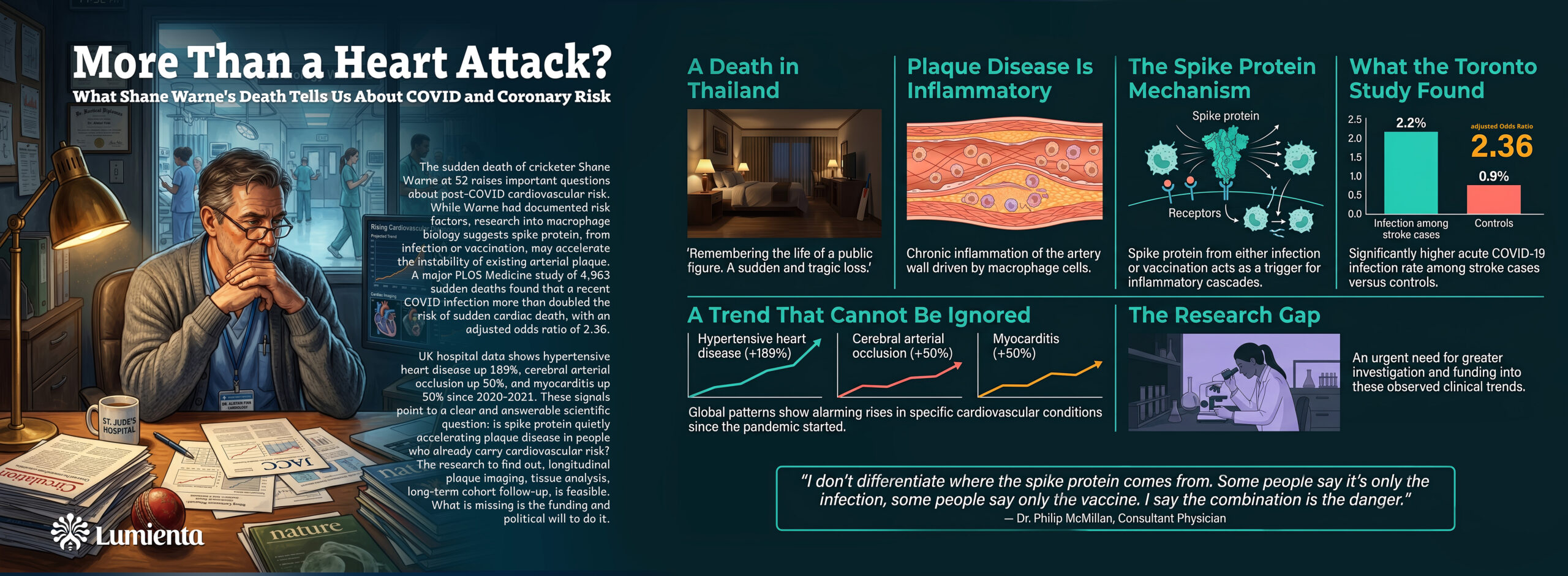
EDUCATION
WHY ARE MIGRAINE, BRAIN FOG,
AND COGNITIVE DECLINE RISING?
REAL DATA. REAL PATTERNS. EXPLORE THE SHIFT.

What’s been missing is clarity.
This course gives you the framework to understand what may be happening.
But more importantly, it gives you access to a live neurological dashboard built from NHS data - so you can actually see the patterns for yourself.
Inside, you’ll be able to explore:
Which neurological conditions are rising
How trends changed after 2020
Where the strongest signals are emerging
How these patterns connect to real-world symptoms
This is not just theory. It’s a structured way to connect:
data
biology
and what people are experiencing day-to-day
MEDICAL NEWS IN BRIEF
NEWS HIGHLIGHTS
🚥 Regular Early-Morning Wakefulness Is Usually Normal, but Stress and Lifestyle Can Make It Chronic: Millions wake at 3am convinced something is wrong. Research explains this is mostly a predictable feature of sleep architecture, worsened by stress and lifestyle habits. Knowing the cause removes the anxiety, and simple behavioral changes can restore uninterrupted sleep for most people. [SOURCE]
🚥 Medical Video Games Improve Patient Understanding and Health Outcomes Better Than Pamphlets or Websites: Patient education often fails because pamphlets and websites don't change behavior. Interactive games let people make health decisions and experience consequences in a safe space. Evidence shows they raise vaccination rates, improve treatment adherence, and even earn FDA approval as prescription therapies. [SOURCE]
🚥 Obesity Impairs Antibody Production After Vaccination but Triggers a Compensatory Lung Immune Response: Standard vaccine development focuses on generating circulating antibodies, but this may not protect people with obesity effectively. New research finds a compensatory T cell response in lung tissue, suggesting vaccine design must account for immune differences in obese populations to ensure adequate protection. [SOURCE]
🚥 New Anti-Clotting Drug Reduces Stroke Recurrence by 26% Without Raising Bleeding Risk in Large Trial: Stroke survivors face a high risk of recurrence, yet existing anti-clotting drugs carry serious bleeding complications. Asundexian targets a different clotting protein, cutting recurrent stroke risk by 26% and fatal strokes by 31%, with no added bleeding. This could represent the biggest advance in secondary stroke prevention in years. [SOURCE]
🚥 Stem Cell-Derived Insulin-Producing Cells Reverse Diabetes in Mice, Clearing a Key Hurdle for Human Treatment: Type 1 diabetes destroys insulin-producing cells, forcing lifelong injections. Scientists have now grown high-quality replacements from stem cells that survive transplantation and restore normal blood sugar in mice. Solving the cell purity problem that stalled earlier attempts brings this approach meaningfully closer to human trials. [SOURCE]
🚥 Senescent "Zombie" Immune Cells Accumulate in Aging Livers and May Drive Fatty Liver Disease and Inflammation: Fatty liver disease affects hundreds of millions worldwide, but the cellular mechanism driving it has been unclear. A new discovery identifies dysfunctional immune cells that accumulate with age and high-fat diets, fueling chronic inflammation. Targeting these cells dramatically reduced liver disease in mice, pointing to a new treatment pathway. [SOURCE]
BOOK NOOK

Set within a child’s nose, ‘Humming Heroes’ features a family of Lymphocytes led by a wise Mother, brave Father, determined Brother, and heroic Baby, confronting invading microorganisms. The story takes an imaginative turn, when a humming melody combines with the Lymphocytes’ song to repel the invaders and restore inner harmony.

"Disease X: Are You Prepared?" is your comprehensive guide to navigating the uncertain future of global health. Drawing from experience and the latest scientific insights, this book offers:
Practical strategies for personal and community preparedness.
Lessons learned from COVID-19 and other outbreaks.
Actionable steps to boost resilience against emerging health threats.
ADVERTISING
Finally, Skincare That Boosts NAD+ At the Source

For decades, skincare has focused on aesthetic results. But we started by asking a different question: what if instead of trying to preserve our skin's youth, we prioritized optimizing our skin's function? That's how Aramore’s NAD+ skincare was born.
Developed by Harvard & MIT scientists, Aramore is a skincare system based on skin’s performance, not just its appearance. NAD+ production slows down significantly as we age, and this causes all the telltale science of aging.
Aramore is the only skincare formulated to help skin produce NAD+ like much younger skin would. The result? Skin that’s stronger, firmer, and more resilient, that not only looks better, but stays healthier over time.
Become An AI Expert In Just 5 Minutes

If you’re a decision maker at your company, you need to be on the bleeding edge of, well, everything. But before you go signing up for seminars, conferences, lunch ‘n learns, and all that jazz, just know there’s a far better (and simpler) way: Subscribing to The Deep View.
This daily newsletter condenses everything you need to know about the latest and greatest AI developments into a 5-minute read. Squeeze it into your morning coffee break and before you know it, you’ll be an expert too.
Subscribe right here. It’s totally free, wildly informative, and trusted by 600,000+ readers at Google, Meta, Microsoft, and beyond.
