
In partnership with


A Message from Dr. McMillan
COVID reinfection is becoming a repeated population exposure rather than an exceptional event.
Each reinfection creates another opportunity for acute illness and post-infectious complications, even when the initial infection appears mild.
The critical question now is what repeated infections mean for population health over years, not simply whether most people recover from the infection they have today.
Dr. Philip McMillan
In this week's September 4, 2026 update:
Covid-19: If COVID-19 was engineered, who is treating the sick?
Vejon: This week’s featured Vejon video
Health: Finishing an antibiotic course was never backed by evidence
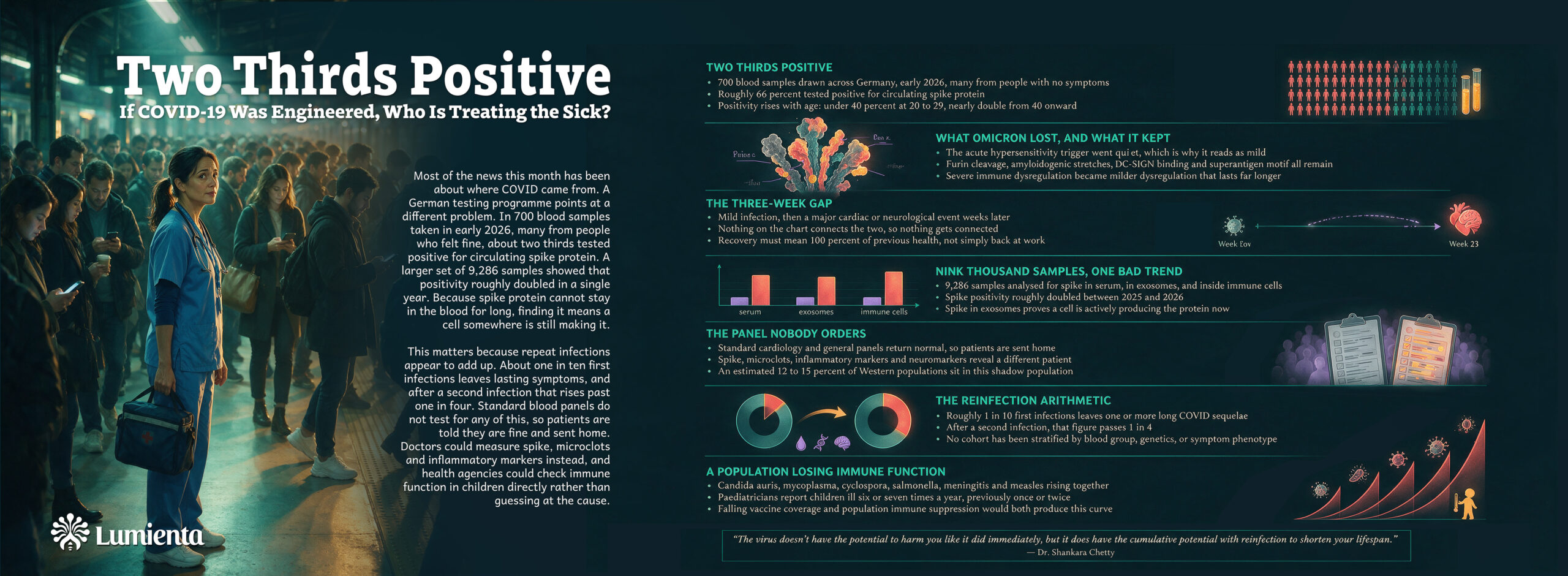
Infographic: Two thirds positive
News: Medical news in brief
Education: Follow the signal. Test the evidence. Explore this gut course.
Read time: 6 minutes
FEATURE ARTICLE
COVID-19
Two thirds positive: If COVID-19 was engineered, who is treating the sick?
Authors: Dr. Philip McMillan, John McMillan

Roughly 66 percent of 700 German blood samples drawn in early 2026 tested positive for circulating spike protein.
Across 9,286 samples, positivity roughly doubled between 2025 and 2026 and climbed steadily with age.
Omicron lost the acute hypersensitivity trigger, but kept furin cleavage, amyloid stretches, DC-SIGN binding and a superantigen motif.
One in ten first infections leaves long COVID sequelae; after a second infection that passes one in four.
Why this is important: Spike protein cannot survive in blood beyond a day, so finding it means a cell somewhere is still making it. Standard panels do not look at this, so patients are declared well and sent home. Origin is a retrospective question; what the virus still does is answerable with one blood test.
BOOKS
|


HEALTH
Finishing every antibiotic course was never backed by evidence, and shorter treatment often works as well
Eef Hogervorst, Loughborough University

The "finish the course" rule rests on a misconception that stopping early breeds resistant bacteria.
Resistance is driven by total antibiotic exposure, which disrupts the microbiome and favours resistant strains.
Trials in bladder, lung and bloodstream infections found short courses matched long ones with fewer side effects.
A 2025 review of 412 studies found about one third of antibiotic prescriptions worldwide are inappropriate.
Why this is important: Eighty years of advice told patients that stopping early was dangerous. The evidence points the other way: every extra day of antibiotics gives resistant bacteria more room. Prescribers now favour three to seven days over fourteen, though deep seated infections and weakened immune systems still need the long course.
INFOGRAPHIC
EDUCATION
This comprehensive data-led course focuses on the intestine as a pandemic amplifier. It is built around a eight-section deep dive through gut immunology, barrier injury, microbiome disruption, and the post-pandemic data dashboard

The Intestine as a Pandemic Amplifier is a comprehensive, data-led course - built around three drivers: repeated spike exposure, barrier injury, and microbiome disruption.
With seven modules, an interactive data dashboard, and Q&A, it takes you section by section through nine years of NHS admission data - so you understand what the numbers show and what they don't.
This is for those who want the evidence tested.
MEDICAL NEWS IN BRIEF
NEWS HIGHLIGHTS
🚥 Toxic dust and PTSD appear to be ageing the brains of 9/11 first responders years ahead of schedule: Trauma is usually filed as a mental health problem and dust as a lung problem. Twenty five years on, both are showing up as amyloid deposits and early dementia in the same people. Exposure limits and protective equipment on the day turn out to be brain protection decades later.
🚥 A small dose of cellular stress can switch on hundreds of protective genes, but the human evidence is thin: Cells respond to a manageable insult as muscle responds to training, by building capacity for the next one. That principle already produced a licensed drug for a rare nerve disease. It does not license sunbathing, pollution or NRF2 supplements, and no blood test yet shows whether the switch is on.
🚥 The immune attack behind tau driven brain damage is primed in lymph nodes, not in the brain: Drugs for dementia have spent decades trying to cross the blood brain barrier. If the damaging immune response is organised outside the brain, that barrier stops mattering. T cell therapies already licensed for other diseases could be tested against neurodegeneration without a single new molecule. [SOURCE]
🚥 The chickenpox virus most of us carry causes strokes, nerve pain and blindness, often without any rash: A virus is easy to dismiss when its signature is a rash that clears in weeks. Strip the rash away and the same virus presents as unexplained stroke, one sided pain or dementia risk that nobody tests for. Antivirals and vaccines exist; the missing step is thinking to look. [SOURCE]
🚥 A multiple sclerosis therapy built from patients' own red blood cells retrains the immune system without suppressing it: Existing MS drugs work by switching off large parts of immunity, which invites infection and cancer. Teaching the immune system to ignore one specific target leaves the rest intact. With more than 100 autoimmune diseases affecting over 5 percent of people, the same trick could reach far beyond MS. [SOURCE]
🚥 Gut bacterial genes track with brain chemical levels in the first direct human study of its kind: Gut brain claims have rested on mouse work and mood questionnaires. Measuring neurotransmitters directly in living human brains and matching them to microbial genes moves the idea onto firmer ground. It remains correlation in a small, uniform group, but hands future trials a measurable target rather than a metaphor. [SOURCE]
SUPPORT VEJON MED
SUPPORT education in science and medicine. Your ONE-TIME donation will help us maintain our independence, compensate our dedicated team, and continue delivering high-quality content free from industry influence.
ADVERTISING
Write docs 4x faster. Without hating every second.

Nobody became a developer to write documentation. But the docs still need to get written — PRDs, README updates, architecture decisions, onboarding guides.
Wispr Flow lets you talk through it instead. Speak naturally about what the code does, how it works, and why you built it that way. Flow formats everything into clean, professional text you can paste into Notion, Confluence, or GitHub.
Used by engineering teams at OpenAI, Vercel, and Clay. 89% of messages sent with zero edits. Works system-wide on Mac, Windows, and iPhone.
Chef-Crafted, Dietitian-Designed Meals Ready in 2 Minutes

Try Factor, America's #1 ready-to-eat meal delivery service.
Made from ingredients you recognize. Whole food. Nothing unnecessary. Let’s eat real.
Get 50% off your first Factor box + Free Breakfast for a year *1 free breakfast item per box for 1 year while subscription active.
