
In partnership with


A Message from Dr. McMillan
COVID showed how quickly a frightened public will trade scrutiny for reassurance.
Answering hard questions about lab safety, early treatment, vaccine limits, and what “unknown pneumonia” actually means was treated as a nuisance instead of a duty.
If that habit of avoiding questions continues, the next outbreak will be managed by press release rather than evidence.
Dr. Philip McMillan
In this week's October 9, 2026 update:
Covid-19: How an ancient bacterium outwits the immune system
Vejon: This week’s featured Vejon video
Health: Healthier eating in older adults linked to better biological ageing
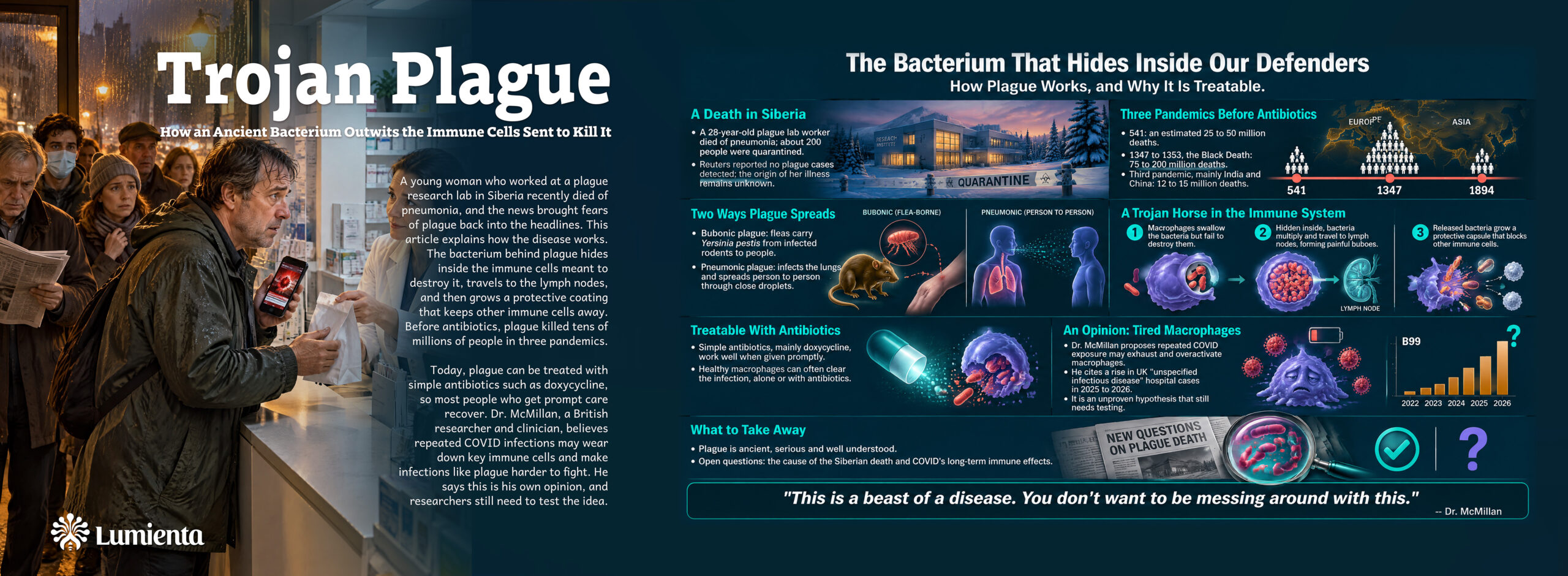
Infographic: Trojan plague
News: Medical news in brief
Education: Follow the signal. Test the evidence. Explore this gut course.
Read time: 6 minutes
FEATURE ARTICLE
COVID-19
Trojan Plague: How an ancient bacterium outwits the immune cells sent to kill it
Authors: Dr. Philip McMillan, John McMillan

A Siberian plague lab worker died of pneumonia; about 200 people were quarantined, and the cause remains unexplained.
The bacterium -Yersinia pestis survives inside macrophages, rides them to lymph nodes, then bursts out wrapped in a protective capsule.
Prompt treatment with inexpensive antibiotics such as doxycycline cures most cases; healthy macrophages often clear the bacteria themselves.
Dr. Philip McMillan speculates repeated COVID infections may exhaust macrophages, leaving people more vulnerable to bacteria like plague.
Why this is important: Plague headlines spark fear, but the bacterium's tactics are well understood and simple antibiotics defeat it. Knowing how it hijacks immune cells separates real risk from alarm, while Dr. McMillan's hypothesis about COVID-weakened macrophages raises a testable question about whether repeated infections leave us less protected.
BOOKS
|

FEATURED VIDEO
Are we at risk for a post-COVID plague outbreak?

HEALTH
Healthier eating patterns in older adults are linked to blood markers of better biological ageing
Rachel Ann Da Costa and Adrian Caraballo Casla, Karolinska Institutet

Karolinska researchers compared diet quality with 54 blood biomarkers in 1,769 Stockholm adults aged 60 and older.
People with healthier diets had higher folate, a B vitamin tied to cognition, and lower GDF-15, a cellular stress signal.
Less inflammatory diets were linked to six favourable markers covering blood sugar, appetite, liver, bone and immune function.
Diet and blood markers were measured simultaneously in healthy, well-educated Swedes, so cause and effect remain unproven.
Why this is important: Superfoods and single supplements dominate ageing advice, yet overall eating patterns may matter more. Linking diet quality to measurable markers of cellular stress, inflammation and metabolism offers a biological explanation for why Mediterranean-style eating may protect against frailty, heart disease and cognitive decline in later life.
EDUCATION
This comprehensive data-led course focuses on the post-pandemic neurological shift. It is built around a three-driver deep dive through meningeal inflammation, choroid plexus dysfunction, cerebral microclotting, and the post-pandemic data dashboard

The Post-Pandemic Neurological Shift is a comprehensive, data-led course - built around three drivers: skull and meningeal inflammation, choroid plexus dysfunction, and cerebral microclotting.
With six modules, an interactive data dashboard, and Q&A, it takes you section by section through nine years of NHS admission data - so you understand what the numbers show and what they don't.
This is for those who want the evidence tested.
MEDICAL NEWS IN BRIEF
NEWS HIGHLIGHTS
🚥 Antidepressants that once worked can lose their effect, but the reasons are unclear and other causes must be ruled out first: In England alone, 9.1 million people received antidepressants in 2025 to 2026, and some will notice symptoms creeping back. Understanding that this can happen, and that it has several possible causes, helps patients avoid stopping abruptly, which risks withdrawal, and encourages a careful review with their prescriber instead.
🚥 A Siberian plague lab worker's death prompted a mass quarantine, but experts judge the public risk to be low: Plague still carries the shadow of the Black Death, so a suspected laboratory case can spark alarm. Clear facts about how the disease spreads, how antibiotics stop it and why the outbreak risk appears low help the public respond calmly, while underlining the need for transparency about lab accidents.
🚥 Ultraprocessed and minimally processed meals with matched nutrients triggered different metabolic and brain responses: Nutrition labels count calories, fat and sugar, but say nothing about processing. Showing that two nutritionally matched meals affect insulin, fuel use and brain reward differently suggests processing itself shapes how the body handles food, a key question in debates over ultraprocessed diets and obesity. [SOURCE]
🚥 Even brief vaping damaged deep lung tissue in lab models and weakened defenses against respiratory viruses: Many people see occasional vaping as a harmless alternative to smoking. Evidence that short exposures injure the deep lung, where oxygen enters the blood, and blunt antiviral defenses suggests even casual use may raise infection risk and, if repeated, could contribute to chronic lung disease. [SOURCE]
🚥 Adults who spend more time helping others tend to have younger-looking brains on MRI scans: Brain health advice usually centres on diet, exercise and puzzles. Linking everyday kindness, like helping a neighbour or supporting a friend, to a younger-looking brain suggests generosity could be a simple, free way to protect the ageing mind, though trials must still show it causes the benefit. [SOURCE]
🚥 Fats damaged by everyday cellular stress may drive the chronic inflammation behind many diseases, a Harvard review finds: Chronic inflammation underlies many of today's most common diseases, yet its triggers are often unclear. Identifying everyday damaged fats as active inflammatory signals, rather than harmless waste, suggests a possible shared mechanism across conditions from asthma to cancer and points toward future treatments that target these molecules directly. [SOURCE]
SUPPORT VEJON MED
SUPPORT education in science and medicine. Your ONE-TIME donation will help us maintain our independence, compensate our dedicated team, and continue delivering high-quality content free from industry influence.
ADVERTISING
Leave Granola and get up to 12 months free of Wispr Flow Notetaker + Dictation

If you have paid time left on an individual Granola plan, we'll match it with a Wispr Flow subscription that includes Notetaker and dictation, and add bonus time, up to 12 months total. Sign in or create a Wispr account and submit proof of your plan to check eligibility.
Men, Say Goodbye to Eyebags, Dark Spots & Wrinkles

Particle Face Cream is a 6-in-1 formula engineered specifically for men's skin. It reduces eye bags, dark spots, and wrinkles, restores firmness, hydrates deeply, and revives dull tone. Multiple premium anti-aging ingredients, clinically researched, built into one product that actually fits your routine.
Over 1,000,000 men have added Particle to their daily routine. Easy, effective, and worth the two minutes. Try it risk-free with a 30-day money-back guarantee.

