
In partnership with


A Message from Dr. McMillan
The failure of another promising vaccine trial, despite strong antibody responses, raises an important question about how well we understand immune function in the post-pandemic era.
If they refuse to examine the possibility that population biology has changed, because of its implications for the COVID narrative, they risk spending billions trying to develop solutions without understanding the problem.
Dr. Philip McMillan
In this week's October 16, 2026 update:
Covid-19: What a failed trial reveals about post-pandemic immunity
Vejon: This week’s featured Vejon video
Health: Blood gene activity may help explain severe COVID-19 in children
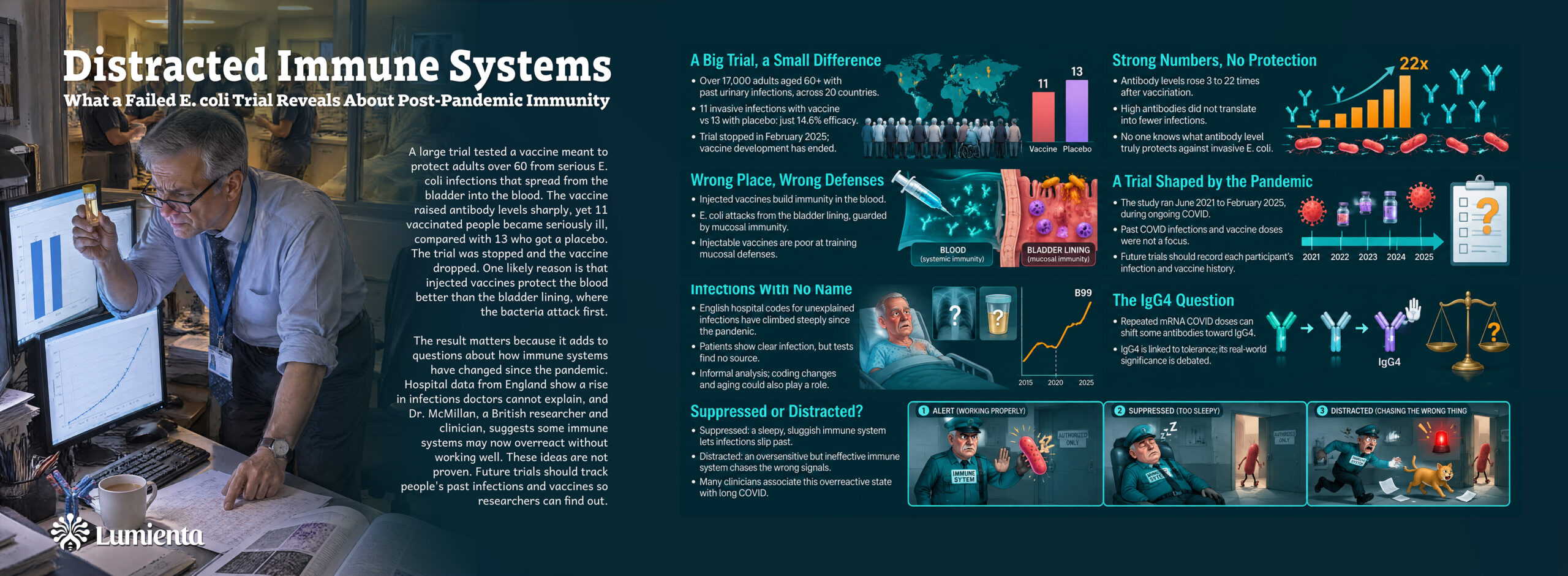
Infographic: Distracted immune systems
News: Medical news in brief
Education: Long Covid in Clinic Course (CPD in progress)
Read time: 6 minutes
FEATURE ARTICLE
COVID-19
Distracted Immune Systems: What a Failed E. coli Trial Reveals About Post-Pandemic Immunity
Authors: Dr. Philip McMillan, John McMillan

An E. coli vaccine for adults over 60 was abandoned after 11 vaccinated and 13 placebo recipients fell seriously ill.
Antibody levels rose sharply and stayed high, yet protection was minimal; no one knows which levels truly protect.
Injected vaccines build blood immunity, but E. coli first attacks the bladder lining, where mucosal defenses matter most.
English hospital codes for unexplained infections have risen; Dr. McMillan suggests immune systems may now be "distracted," not suppressed.
Why this is important: Vaccines that raise antibodies can still fail to prevent disease, a lesson with real consequences for older adults prone to dangerous infections. Recording participants' COVID infections and vaccine doses in future trials could reveal whether post-pandemic immune systems now respond differently, and help design vaccines that protect where infections begin.
BOOKS
|


HEALTH
Blood gene activity may help explain why some children become seriously ill with COVID-19
Negusse Tadesse Kitaba, Heather Zar, John W Holloway, University of Southhampton

Southampton and Cape Town researchers analysed blood gene activity in 333 South African children with and without respiratory infections.
Children with severe respiratory infections showed over 5,000 altered genes, stronger neutrophil and interferon-gamma responses, and fewer T cells.
Seven immune cell types behaved similarly across COVID-19, RSV and tuberculosis, while other patterns were unique to each infection.
Researchers identified 82 genes that may separate severe from mild COVID-19, but larger studies must confirm them.
Why this is important: Most children shrug off COVID-19, yet a small number become dangerously ill, and doctors struggle to predict which ones. Gene activity patterns that flag severe illness could eventually lead to a blood test identifying vulnerable children early, guiding closer monitoring and treatment before their breathing deteriorates.
EDUCATION
Follow the Science.
Test the Framework
Build With This CPD Course
This clinician CPD course is being built live over the coming weeks — a structured, evidence-graded walk through Long COVID: the mainstream consensus, why one-size trials fall short, severe versus mild disease, and the macrophage framework

Long COVID in Clinic is a clinician CPD course, built around the macrophage hypothesis: spike persistence, barrier injury and immune dysregulation, labelled for what each claim can bear.
Across fifteen modules, a clinical case library and live Q&A, it works section by section through how to reason when the tests come back normal - what the science shows, and what it doesn’t.
The course is released section by section, and the price rises each week as new sections go live. Lock in today’s rate and every future section is included at the price you joined.
MEDICAL NEWS IN BRIEF
NEWS HIGHLIGHTS
🚥 Pope Leo XIV's lung cancer diagnosis spotlights rising rates among women, younger people and those who never smoked: Many people still think of lung cancer as a smoker's disease, so symptoms in nonsmokers, women and younger adults are often dismissed. Recognizing that anyone can develop it encourages earlier medical attention, research into hidden risks and genes, and broader screening that could catch more cancers while still curable.
🚥 A common gut bacterium makes a fatty acid that halved artery plaque in mice by acting like a statin: Statins save lives, but some people cannot tolerate them. Discovering that a gut microbe naturally makes a cholesterol-lowering compound points to new ways to protect arteries, perhaps through probiotics, diet or new drugs, though results in mice must be confirmed in people before anyone changes treatment. [SOURCE]
🚥 Ovaries keep changing at the molecular level for decades after menopause rather than simply shutting down: The ovary is often seen as switching off once periods stop. Evidence that it stays biologically active for decades raises important questions about its role in later-life health, whether healthy ovaries should be removed after menopause, and how ovarian aging might open doors to earlier cancer detection. [SOURCE]
🚥 Middle-aged adults who eat the most ultra-processed food are more likely to show silent brain damage on MRI: Silent brain injuries cause no obvious symptoms but are early warning signs of stroke and dementia. Linking them to ultra-processed food in adults as young as 35 suggests diet may affect brain health decades before problems appear, offering another reason to favor whole foods. [SOURCE]
🚥 Certain bacteria on the tongue are linked to faster thinking in adults, an exploratory study finds: Mouth bacteria are easy to sample and can be influenced by diet and oral hygiene. If larger studies confirm that particular tongue bacteria track with mental sharpness, a simple swab might one day help monitor brain aging, and caring for oral health could become part of protecting cognition. [SOURCE]
🚥 The quality of bystander CPR may shape whether people survive a cardiac arrest outside hospital: When the heart stops outside hospital, a bystander's hands are often the only lifeline before paramedics arrive. Showing that CPR quality, not just whether it happens, may influence survival makes a strong case for wider training, better measurement and live guidance during emergency calls. [SOURCE]
SUPPORT VEJON MED
SUPPORT education in science and medicine. Your ONE-TIME donation will help us maintain our independence, compensate our dedicated team, and continue delivering high-quality content free from industry influence.
ADVERTISING
Men, Say Goodbye to Eyebags, Dark Spots & Wrinkles

Particle Face Cream is a 6-in-1 formula engineered specifically for men's skin. It reduces eye bags, dark spots, and wrinkles, restores firmness, hydrates deeply, and revives dull tone. Multiple premium anti-aging ingredients, clinically researched, built into one product that actually fits your routine.
Over 1,000,000 men have added Particle to their daily routine. Easy, effective, and worth the two minutes. Try it risk-free with a 30-day money-back guarantee.
Fresh-Roasted Coffee, Without Leaving the House

A third-generation LA roaster ships 50+ coffees — single origins, flavored favorites, decafs, even teas — days after roasting. Mix and match Keurig®-compatible boxes for tiered savings up to 34% off. First order? Take an extra 15% off, automatically.

